Custom vs Ready-Made Healthcare Software: Which Is Better?
Choosing the right technology foundation for your healthcare practice or hospital is one of the most important decisions you'll make as a healthcare administrator or business owner
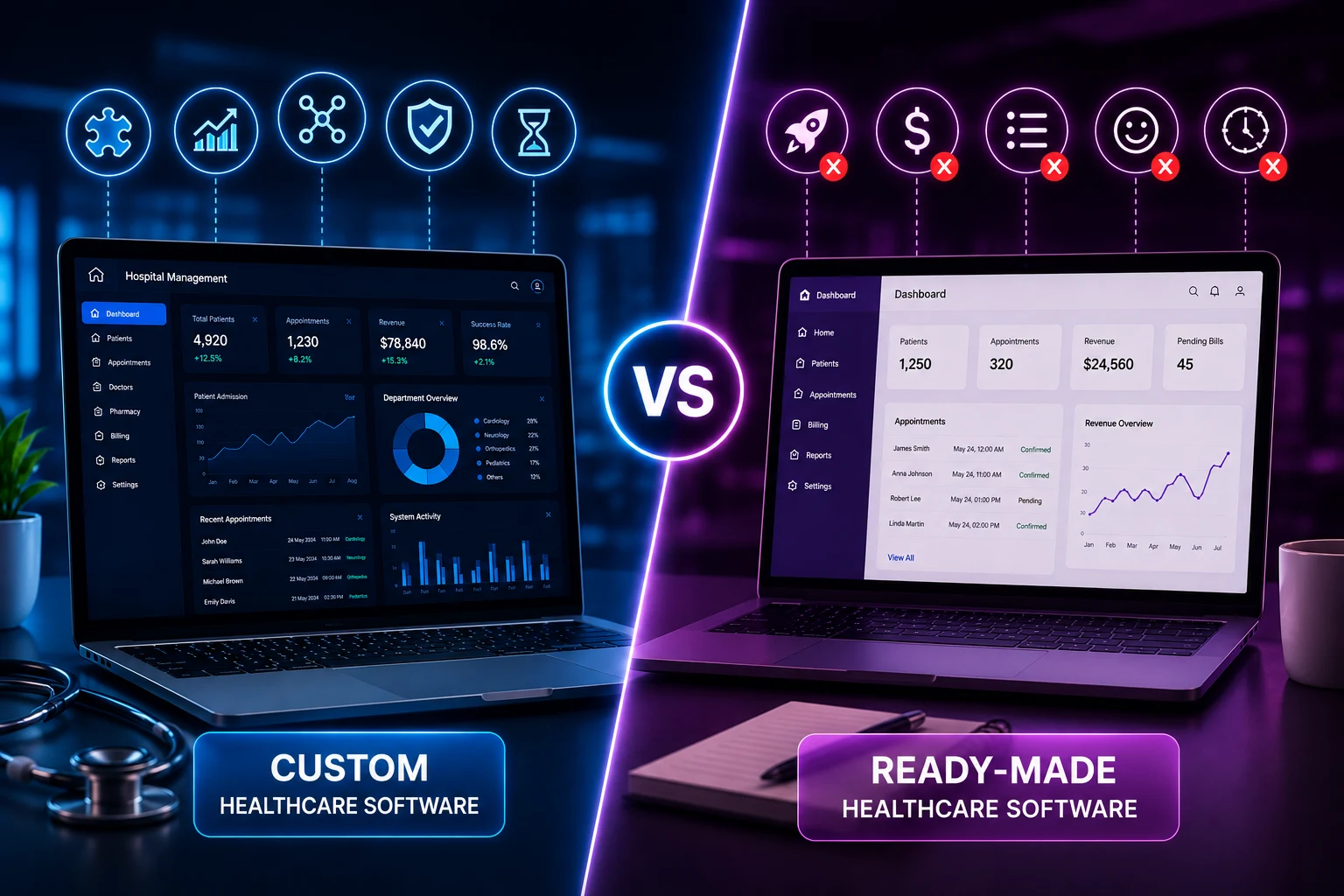
Choosing the right technology foundation for your healthcare practice or hospital is one of the most important decisions you'll make as a healthcare administrator or business owner. The debate between building custom software and purchasing ready-made healthcare solutions has significant implications for patient care quality, operational efficiency, data security, and long-term costs. This guide provides an honest, detailed comparison to help you decide which approach is right for your healthcare organization.
Why This Decision Matters More in Healthcare Than Other Industries
Patient Safety Is at Stake
Unlike many other business software decisions, healthcare technology directly impacts patient safety. A poorly fitted software solution can lead to medication errors, missed appointments, lost patient records, or delayed treatment—consequences far more serious than typical business inefficiencies.
Regulatory Compliance Requirements
Healthcare software must comply with strict data protection and clinical documentation standards. Whether you choose custom or ready-made solutions, compliance with relevant healthcare data regulations is non-negotiable, and this requirement shapes which approach makes more sense for your organization.
Complex, Specialized Workflows
Healthcare delivery involves intricate workflows—patient intake, clinical documentation, prescription management, billing, insurance claims, lab integration—that vary significantly between specialties, facility types, and even individual practice preferences. Generic software often struggles to accommodate this complexity well.
Understanding the Two Approaches
What Is Ready-Made Healthcare Software?
Ready-made healthcare software includes commercial electronic health record (EHR) systems, practice management platforms, and clinic management software designed to serve many healthcare providers with similar, standardized features. These solutions are typically licensed or subscribed to, with configuration options but limited fundamental customization.
What Is Custom Healthcare Software Development?
Custom development means partnering with a custom healthcare software development company to build software specifically designed around your organization's unique workflows, specialty requirements, patient population, and operational structure. Every feature is built to match exactly how your healthcare practice actually operates.
Ready-Made Healthcare Software: Advantages
Faster Implementation
Ready-made systems can often be deployed within weeks, since the core functionality already exists. For practices needing to digitize quickly, this speed advantage is meaningful.
Lower Initial Investment
Subscription-based ready-made solutions typically have lower upfront costs compared to custom development, making them accessible for smaller practices or those with limited initial technology budgets.
Established Compliance Frameworks
Many established healthcare software vendors have already built compliance frameworks into their products, having gone through certification processes that smaller custom projects might need to build from scratch.
Vendor-Provided Support and Updates
Commercial healthcare software typically comes with vendor support teams, regular updates, and established troubleshooting processes that don't require your own technical staff.
Ready-Made Healthcare Software: Limitations
Generic Workflows That Don't Fit
Most ready-made systems are built for broad applicability across many practice types, often resulting in workflows that don't match how your specific specialty or facility actually operates—forcing staff into inefficient workarounds.
Limited Customization
Fundamental changes to how the software works, what data it captures, or how information flows between modules are often impossible or extremely limited with commercial off-the-shelf systems.
Ongoing Licensing Costs That Scale
Per-user or per-provider licensing fees accumulate significantly as practices grow, often making ready-made solutions more expensive than anticipated over a multi-year period.
Integration Challenges
Connecting ready-made software with other systems—lab equipment, specialized diagnostic tools, existing patient databases—can be difficult or impossible if the vendor hasn't built specific integrations for your tools.
Feature Bloat and Complexity
Generic systems designed for broad markets often include numerous features irrelevant to your practice, creating unnecessarily complex interfaces that increase training time and reduce staff efficiency.
Custom Healthcare Software Development: Advantages
Built Around Your Exact Clinical Workflows
A custom healthcare software development company designs every screen, form, and process around how your specific practice actually delivers care—not a generic approximation that requires adaptation.
Seamless Integration with Existing Systems
Custom software can be built specifically to integrate with your existing lab equipment, diagnostic tools, billing systems, and any other technology already in use at your facility.
Scalability Aligned with Your Growth
As your practice grows—adding providers, locations, or services—custom software can be designed from the start to scale with these changes, rather than hitting licensing tiers or feature limitations.
Complete Ownership and Data Control
You own your custom software outright, along with full control over how patient data is stored, processed, and protected—an important consideration for healthcare organizations with specific data governance requirements.
Competitive Differentiation
For healthcare organizations building patient-facing portals or telehealth platforms, custom software allows for distinctive patient experiences that reflect your brand and approach to care, rather than looking identical to competitors using the same commercial platform.
Custom Healthcare Software Development: Limitations
Higher Upfront Investment
Building custom software requires more significant initial investment in design, development, and testing compared to subscribing to existing platforms.
Longer Development Timeline
Custom healthcare software, particularly systems requiring regulatory compliance validation, takes considerably longer to build and deploy than activating a ready-made system.
Requires the Right Development Partner
Success with custom healthcare software depends heavily on choosing a development partner with genuine healthcare domain expertise—not just general software development skills.
Why Custom Development Wins for Most Growing Practices
Practice Size and Complexity
Even smaller, single-specialty practices often discover within a year or two that ready-made solutions feel restrictive as patient volume grows and workflows mature. Larger, multi-specialty practices or hospitals with complex, unique workflows see this limitation almost immediately—making custom development the more future-proof choice from the start.
Specialty-Specific Requirements
Specialties with highly specific documentation or workflow needs—such as dermatology with extensive imaging requirements, or mental health with specific session documentation needs—consistently find generic EHR systems poorly suited to their actual clinical work. A custom healthcare software development company eliminates this mismatch entirely by designing around your specialty from day one.
Integration Requirements
If your practice relies on specialized equipment or existing systems that need deep integration, custom development is often the only reliable way to achieve seamless data flow without the ongoing frustration of unsupported or partial integrations.
Long-Term Growth Plans
Practices with growth plans—adding locations, expanding services, building patient-facing digital experiences—consistently find that custom software provides significantly better long-term flexibility and total value, even though ready-made platforms may look more affordable on day one.
Budget and Timeline Realities
If your timeline is extremely tight or your budget is genuinely limited right now, a ready-made solution may serve as a short-term bridge. However, this should be treated as a temporary stepping stone rather than a permanent strategy, with custom development planned as the practice stabilizes and grows.
A Hybrid Approach Worth Considering
Some healthcare organizations successfully combine approaches—using established EHR systems for core clinical documentation and compliance-critical functions while commissioning custom software for patient engagement, telehealth, or specialized departmental workflows that the EHR doesn't handle well. This hybrid strategy can balance compliance assurance with the flexibility custom development provides where it matters most.
What to Look for in a Custom Healthcare Software Development Company
If you decide custom development is right for your organization, evaluate potential partners based on:
Demonstrated experience building healthcare-specific software
Understanding of relevant healthcare compliance requirements
Ability to design intuitive interfaces that don't disrupt clinical workflows
Strong data security practices appropriate for protected health information
Willingness to genuinely understand your specific clinical processes before proposing solutions
Conclusion
While ready-made healthcare software can seem appealing for its lower upfront cost and faster deployment, it ultimately asks your practice to compromise—forcing clinical teams to adapt their workflows around generic software rather than having software that adapts to how care is actually delivered. In an industry where every minute of provider time and every accurate data point directly affects patient outcomes, these compromises carry real costs that often outweigh the initial savings.
Working with an experienced custom healthcare software development company removes these compromises entirely. Custom software is built around your exact clinical workflows, integrates seamlessly with your existing equipment and systems, scales naturally as your practice grows, and gives you complete ownership and control over your patient data and technology roadmap. Rather than paying recurring licensing fees for features you don't need while missing the ones you do, you invest once in a system engineered specifically for your organization—one that becomes a genuine competitive advantage rather than a constraint.
For healthcare organizations serious about optimizing patient care delivery, improving operational efficiency, and building technology that supports growth rather than limiting it, custom development is consistently the better long-term choice.
If your practice is ready to move beyond the limitations of generic, one-size-fits-all software, explore our healthcare software development services to see how a custom-built solution can transform your patient care and daily operations.