
Static vs Dynamic Website: Which One Fits Your Business?
When you decide to build a website for your business, one of the first decisions your web development team will bring up is whether you need a static or a dynamic website.
If you are not a developer, these two terms can sound unnecessarily technical. But the choice between them has real, practical consequences for how your website works, how much it costs, and whether it actually serves your business goals.
This guide explains what static vs dynamic websites actually mean in plain language — without unnecessary jargon — and gives you a clear framework for deciding which one is right for your business.
Let's Start with the Basics
Before comparing the two, you need to understand what each one is and how it works.
What Is a Static Website?
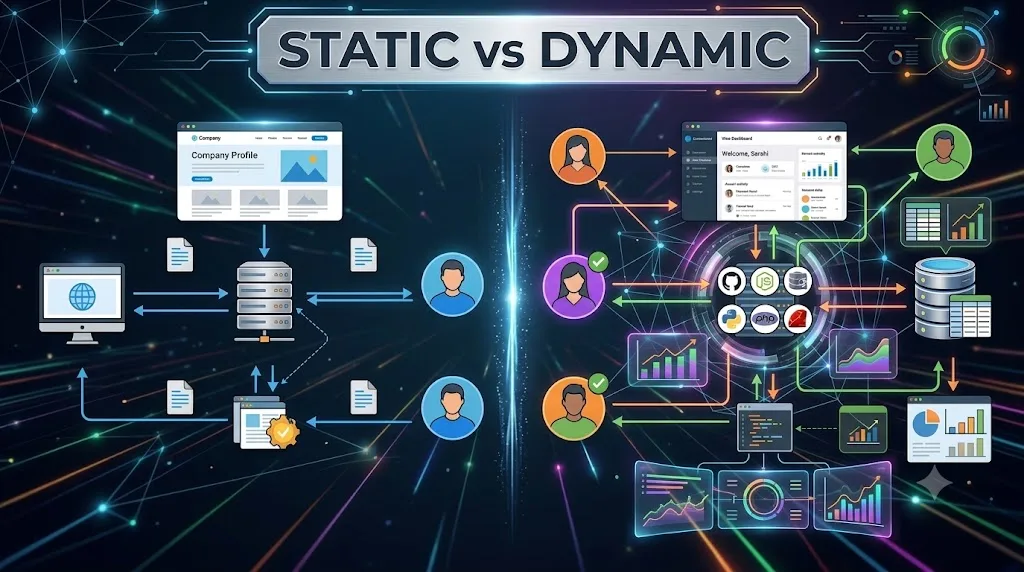
A static website delivers the same fixed content to every visitor every time. Each page is a pre-built file that sits on a server, and when a visitor requests that page, the server sends the file directly to their browser — nothing changes, nothing is generated on the fly.
Think of it like a printed brochure. Everyone who picks it up reads the same content. The brochure does not change based on who you are, what you are looking for, or when you are reading it.
Static websites are called "static" because the content stays the same until a developer manually edits the file and re-uploads it.
What Is a Dynamic Website?
A dynamic website generates content on demand. When a visitor requests a page, the server pulls information from a database, processes it, and assembles the page specifically for that visitor at that moment.
Think of it like a conversation. The content you see depends on who you are, what you searched for, what is in your cart, what time it is, or dozens of other variables. The page is built fresh each time it is requested.
Dynamic websites are called "dynamic" because the content can change based on user behaviour, database updates, login status, time, location, or any other variable the website is programmed to consider.
The Practical Difference in Real Life
Here is how this plays out in actual business scenarios:
A small architecture firm wants a website to showcase their portfolio and allow potential clients to contact them. Every visitor sees the same portfolio, the same services page, and the same contact form. This is a static website use case.
An online clothing store wants a website where customers can browse products, filter by size and colour, add items to a cart, create accounts, complete purchases, and track orders. The content changes based on what is in stock, what the customer has in their cart, and who is logged in. This is a dynamic website use case.
Most real businesses fall somewhere between these two extremes — and understanding where you fall on that spectrum is the key to making the right choice.
Static Websites: When They Work Best
Advantages of Static Websites
Speed
Static websites are fast. Because no database query or server-side processing is needed to generate a page, they respond almost instantly. A fast website improves user experience and search engine rankings — both commercially important outcomes.
Simplicity and Security
Fewer moving parts mean fewer things that can break or be exploited. Static websites have a significantly smaller attack surface than dynamic ones because there is no database to breach and no server-side code to exploit.
Lower Cost
Building a static website is generally less expensive than a dynamic one. There is no database to design, no server-side logic to develop, and no complex infrastructure to maintain. Hosting costs are also typically lower.
Easy Maintenance
For small websites with infrequent content changes, static sites are easy to maintain. There is no database to back up, no plugins to update, and no server software to patch.
When a Static Website Makes Sense
A static website is a good fit when:
Your content changes infrequently — a services page, an about page, a portfolio, contact information
You do not need user accounts, logins, or personalised experiences
Your business model does not require transactions processed on the website
You have a small number of pages that a developer can update when needed
Budget is a significant consideration and functionality needs are straightforward
Examples: A law firm's informational website, a personal portfolio, a restaurant's menu and location page, a small clinic's service and contact page, a construction company's project showcase.
The Honest Limitation of Static Websites
Static websites have a ceiling. Once your business needs the website to do more than present fixed information — once you need user accounts, dynamic content, ecommerce, booking systems, or anything that requires data to change based on user interaction — a static website cannot accommodate this without becoming, in effect, a dynamic website.
Many businesses start static and then need to rebuild entirely when their needs grow. If you anticipate significant functionality needs in the near future, it is often more cost-effective to build dynamically from the start.
Dynamic Websites: When They Work Best
Advantages of Dynamic Websites
Content That Updates Automatically
Dynamic websites pull content from a database, which means when you update information in one place, it updates everywhere it appears across the site. A hotel changing its room rates updates them on the room page, the booking page, and the comparison table simultaneously — with one edit.
Personalised User Experiences
Dynamic websites can show different content to different users — logged-in customers see their order history, visitors who searched for running shoes see running-related recommendations, users in Kochi see local pricing. This personalisation directly drives engagement and conversions.
Scalability for Large Content Libraries
A static website with ten pages is manageable. A static website with ten thousand product listings is impractical — each page would need to be created and maintained individually. A dynamic website generates these pages from a database, making large content volumes completely manageable.
User Accounts and Interactions
Anything requiring a user to log in, create a profile, submit information that gets stored, or interact with data that persists between sessions requires dynamic functionality. This includes ecommerce stores, membership sites, booking platforms, patient portals, student management systems, and countless other business use cases.
Easy Content Management Without a Developer
Most dynamic websites use a content management system (CMS) that allows non-technical team members to add blog posts, update service descriptions, upload new products, and manage content independently — without editing code or contacting a developer for every change.
When a Dynamic Website Makes Sense
A dynamic website is the right choice when:
Your content changes regularly and needs to be managed by your team without developer involvement
You need user accounts, logins, or personalised experiences
You are selling products or services online and need cart, checkout, and order management
You have a large volume of content — products, listings, articles, properties — that would be impractical to manage as individual static files
You need integration with third-party systems — payment gateways, booking platforms, CRM tools, inventory management
You want a blog or news section with regular publishing
Examples: An ecommerce store, a hospital with patient portals and appointment booking, a real estate agency with hundreds of property listings, an educational institution managing courses and student accounts, a restaurant chain with online ordering across multiple locations.
The Cost Question: Static vs Dynamic
This is often the deciding factor for businesses with tight budgets, so it deserves an honest breakdown.
Static Website Costs
Static websites are generally less expensive to build because they require less development work — no database design, no server-side programming, no CMS integration. Hosting is also cheaper because static files can be served from simple, inexpensive infrastructure.
The ongoing cost is minimal as long as content changes are infrequent. If you need a developer to make every content change, and changes happen often, that developer cost accumulates.
Dynamic Website Costs
Dynamic websites cost more to build because of the additional layers — database design, server-side logic, CMS integration, user authentication, and all the functionality that makes the site do more than display fixed content.
However, the long-term cost of a well-built dynamic website is often lower than people expect — particularly once you factor in the value of your team being able to manage content independently, the ability to add features without rebuilding, and the scalability that avoids costly platform migrations as the business grows.
The Real Question Is Value, Not Cost
The right question is not "which is cheaper?" but "which delivers more value for my specific business?" A static website that costs less to build but cannot serve your actual business needs is not a good investment. A dynamic website that costs more upfront but handles everything your business needs for the next five years is a significantly better one.
Performance and SEO: Does the Choice Matter?
This is a common concern, and the honest answer is nuanced.
Speed and Performance
Static websites have a natural speed advantage because there is no server-side processing required to serve a page. This can translate to better Core Web Vitals scores and faster perceived loading times.
However, modern dynamic websites — when built well and optimised properly — can match or closely approach static website speeds through caching, content delivery networks, and efficient database queries. A poorly optimised static website can actually be slower than a well-optimised dynamic one.
SEO Implications
Neither static nor dynamic websites have an inherent SEO advantage. What matters for SEO is page speed, content quality, proper technical implementation, mobile responsiveness, and the structure of URLs and metadata — all of which can be achieved with either approach.
The SEO advantage that static websites sometimes have in practice is speed-related. The SEO advantage that dynamic websites can have is the ability to publish regular content through a blog or news section, which builds long-term organic visibility.
Security: Which Is Safer?
Static websites have a genuine security advantage because they have no database to compromise, no user authentication system to exploit, and no server-side code to attack.
Dynamic websites have more potential attack surfaces — databases, login systems, form processing, third-party integrations. However, modern dynamic website development with proper security practices — input validation, parameterised queries, secure authentication, regular updates — produces websites that are secure in practice even if theoretically more complex.
The security risk of a dynamic website is a reason to build it properly, not a reason to avoid it when your business needs it.
A Practical Decision Guide
Use this to clarify which type fits your business:
You probably need a static website if:
Your website is primarily informational — a digital brochure for your business. Your content changes rarely. Your team does not need to update the website independently. You have five to twenty pages covering your services, team, portfolio, and contact information. Budget is tight and your needs are straightforward.
You probably need a dynamic website if:
You sell products or services online and need ecommerce functionality. You want to regularly publish blog posts, news, or updates without developer involvement. You need user accounts, booking systems, or personalised experiences. You have a large content library — products, listings, articles, case studies — that would be impractical to manage as static files. You anticipate growing your website's functionality significantly over the next one to three years.
When you are not sure:
If you are building a small informational website now but expect to add a blog, booking system, or online store within the next year, building dynamically from the start avoids a costly rebuild later. Discuss your anticipated growth with your web development team so they can advise on the most cost-effective approach for your specific trajectory.
What About Website Builders and Platforms?
Many businesses build their first website using platforms like Wix, Squarespace, or Shopify. These are worth addressing in the static vs dynamic conversation because they blur the line.
Most modern website builders are technically dynamic under the hood — they use databases and server-side processing — but they abstract this complexity away from the user. For simple business websites, these platforms offer the ease of static-like management with some dynamic capabilities.
The limitations of platform-based websites become apparent when businesses need functionality that the platform does not support, integrations that require custom development, design flexibility beyond the platform's templates, or performance optimisations that the platform does not allow.
Custom-built websites — whether static or dynamic — offer more flexibility, better performance optimisation, and greater long-term adaptability than platform-based alternatives, at the cost of higher initial development investment.
Working with a Web Development Partner
Whether you choose static or dynamic, the quality of the development team executing your website has more impact on the final result than the technical category.
A poorly built dynamic website is slower, less secure, and less effective than a well-built static one. A well-built dynamic website serves a business's actual needs in ways that no static alternative can match.
When working with a professional web development service, share your business goals, your content management needs, your growth plans, and your budget openly. A good development team will give you an honest recommendation — not push you toward the more expensive option if a simpler one genuinely serves you better, and not undersell you on a simpler solution when your business needs something more capable.
Conclusion
The static vs dynamic website choice is not about which is technically superior — it is about which fits your business's actual situation.
Static websites are fast, simple, affordable, and perfectly suited to businesses with straightforward informational needs and infrequent content changes. Dynamic websites are powerful, flexible, and essential for businesses that need content management independence, user accounts, ecommerce, large content libraries, or personalised experiences.
Most growing businesses eventually need dynamic websites. The question is whether you need one now or whether you can start simpler and grow into it. The answer depends entirely on your specific business goals, your current and near-future functionality needs, and how your team needs to manage your online presence day to day.
Explore our web development services to talk through your specific situation with a team that builds both — and will give you an honest recommendation based on what your business actually needs rather than what costs the most to build.