Benefits of Custom Ecommerce Development for Your Business
Most businesses starting an online store face the same first question — should I use a ready-made platform like Shopify or WooCommerce, or should I build something custom?
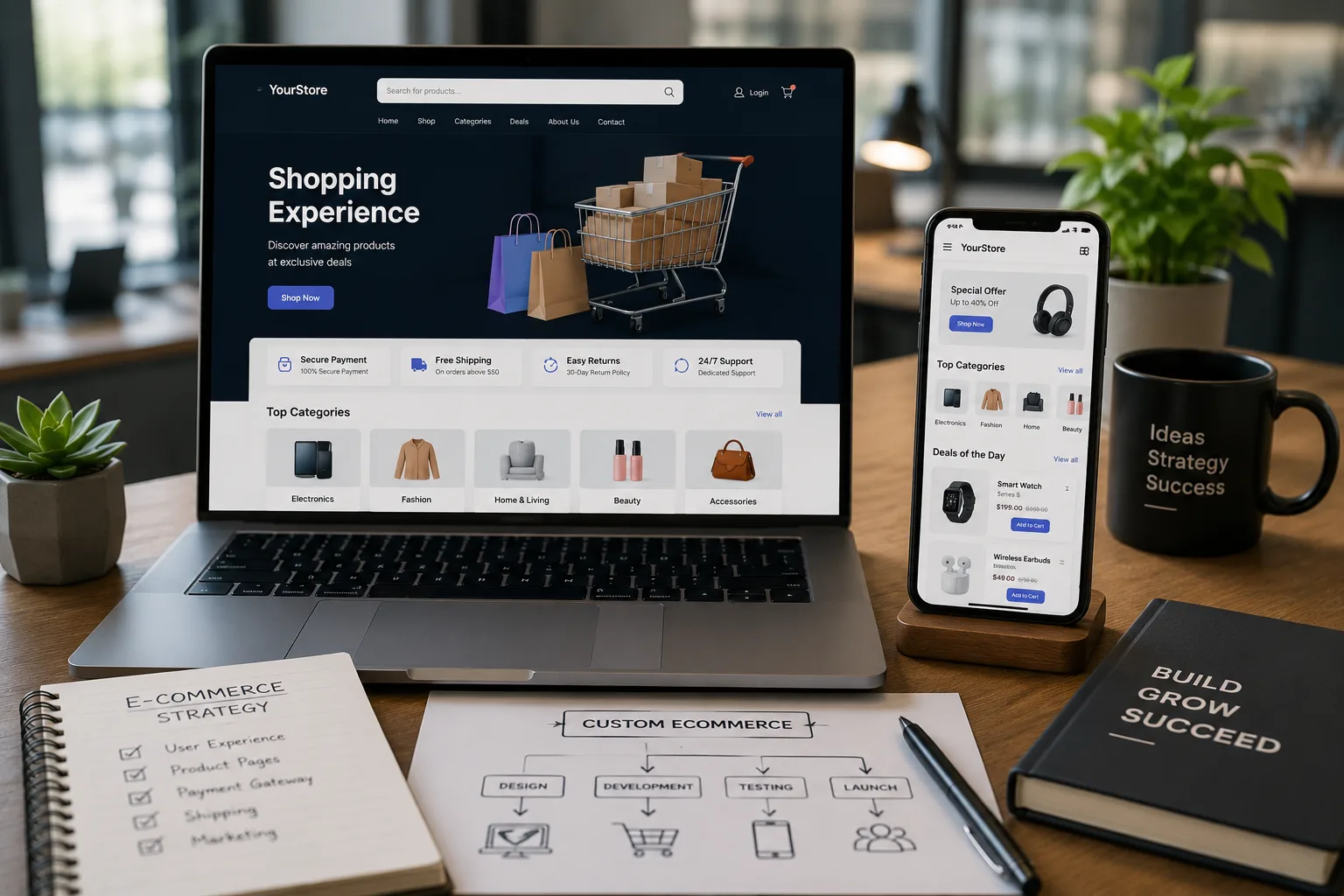
Ready-made platforms are appealing. They are quick to set up, easy to manage, and affordable upfront. For many businesses, they work well — especially in the early stages.
But there comes a point for many growing businesses where the platform starts working against them. Features are missing. Design is limited. The checkout cannot be customised. Performance is slowing down. Scaling is expensive. The platform that felt like a shortcut starts feeling like a ceiling.
That is exactly where custom ecommerce development comes in.
This article explains what custom ecommerce development is, who it is for, and the specific benefits it delivers — so you can decide whether it is the right choice for your business.
What Is Custom Ecommerce Development?
Custom ecommerce development means building your online store from scratch — specifically designed and engineered for your business, your products, your customers, and your operational requirements.
Nothing is borrowed from a template. Nothing is limited by a third-party platform's feature set. Every part of your store — the design, the checkout flow, the product management system, the payment integrations, the backend logic — is built exactly the way your business needs it to work.
It is the opposite of picking a theme and filling in your details. It is a digital product built purposefully, from the ground up, around your specific goals.
10 Key Benefits of Custom Ecommerce Development
1. Your Store Is Built Around Your Business — Not the Other Way Around
This is the most fundamental benefit of going custom — and it is the one that makes every other benefit possible.
With Shopify or WooCommerce, you adapt your business to fit the platform's structure, features, and limitations. Some things will not be possible. Some workflows will not be natural. Some features will need expensive workarounds — or simply will not exist.
With a custom ecommerce platform, there are no constraints. Your store is architected around your actual products, your actual customers, and your actual business model — whether that is B2C retail, B2B wholesale, a multi-vendor marketplace, a subscription model, a D2C brand, or any combination of these.
The platform serves your business. Not the other way around.
2. Complete Control Over Design and User Experience
The shopping experience your customers have directly affects how many of them buy — and how many come back.
With a ready-made platform, your design options are limited to what the platform's theme system allows. You can customise colours and fonts, but the underlying structure is largely fixed. Thousands of other stores are built on the same themes. Standing out is difficult.
With custom ecommerce development, your store's design is entirely unique. Every page, every interaction, every visual element is designed specifically for your brand and your customers. You control exactly how products are presented, how the checkout flows, how the mobile experience feels, and how the overall brand identity comes through in every detail.
A unique, conversion-focused design is one of the biggest competitive advantages an ecommerce business can have — and custom development is the only way to fully achieve it.
3. Unique Features Built Exactly for Your Needs
Every ecommerce business has specific feature requirements. Some are straightforward. Some are genuinely unique — requirements that no off-the-shelf platform can satisfy without expensive, unreliable workarounds.
Custom ecommerce development lets you build exactly the features your business needs:
Complex product configurators — where customers build their own product with custom options
Advanced B2B pricing — different price tiers for different customer accounts or order volumes
Multi-vendor marketplace functionality — with individual seller dashboards, commission structures, and vendor management
Custom subscription and recurring billing logic
Industry-specific workflows — for healthcare, education, food delivery, rental businesses, and more
Deep integrations with your existing ERP, CRM, or warehouse management systems
With a custom platform, if your business needs it — it can be built. No limitations. No workarounds. No compromises.
4. Superior Performance and Speed
Website speed is directly tied to sales. Research consistently shows that even a one-second delay in page load time significantly reduces conversion rates. On mobile — where the majority of Indian shoppers browse and buy — this impact is even greater.
Ready-made platforms carry a lot of code overhead. They are built to serve every type of business, which means they include a large amount of functionality that your store does not need — all of which adds to page weight and slows things down.
A custom ecommerce platform is built lean — only the code your specific store needs. Optimised from the architecture level, with compressed assets, efficient database queries, CDN integration, and cloud infrastructure sized for your traffic. The result is a store that loads faster, handles traffic spikes without performance degradation, and delivers a consistently smooth experience — even during peak sale periods.
5. Scales With Your Business Without Limitations
Ecommerce platforms have scaling limits. As your product catalogue grows, your order volume increases, and your traffic spikes during sales — platform-based stores can struggle to keep up. Performance degrades. Platform fees increase. Feature limitations become more painful.
A well-architected custom ecommerce platform is built to scale. The infrastructure can be scaled horizontally as your traffic grows. The database can handle millions of products and thousands of concurrent orders. New features can be added without rebuilding the platform. New markets, new languages, new currencies — all can be accommodated without platform restrictions.
For businesses with serious growth ambitions, a custom platform is a long-term investment that grows with them — rather than a platform they will need to migrate away from in two years.
6. Full Ownership — No Platform Dependency
When you build your ecommerce store on a third-party platform, you are dependent on that platform. If Shopify increases its pricing, changes its policies, removes a feature you rely on, or in an extreme scenario shuts down — you are subject to those decisions. You are building your business on rented land.
With a custom ecommerce platform, you own everything. The code, the data, the design, the infrastructure — it all belongs to you. No monthly platform fees eating into your margins. No per-transaction charges on every order. No dependency on a third party's commercial decisions.
This ownership gives you long-term stability, freedom, and control over your own digital business.
7. Stronger SEO Capability
Organic search traffic is one of the most valuable, cost-effective sources of customers for any ecommerce business. And your ability to compete in search rankings is directly influenced by the technical quality of your platform.
Custom ecommerce platforms can be built with SEO at the architecture level — clean URL structures, schema markup for every product and category, fast load speeds, Core Web Vitals compliance, proper canonical handling, sitemap generation, and full control over every meta element.
Ready-made platforms offer some of these capabilities, but always with limitations. Custom development removes those limitations entirely — giving your store the strongest possible SEO foundation from day one and allowing your technical SEO to evolve freely as search best practices change.
8. Advanced Security and Data Protection
For any ecommerce business, security is not optional. You are handling customer payment data, personal information, and order history — and any breach damages your customers and destroys your brand reputation.
Custom ecommerce platforms can be built with security as a first principle — not as a checkbox. Secure coding practices, data encryption, robust authentication, regular security audits, and compliance with relevant data protection standards can all be built into the platform from the foundation up.
You are not sharing security infrastructure with thousands of other stores on the same platform. You are not dependent on a platform provider's security response times. Your security architecture is built specifically for your store and maintained by your development partner.
9. Seamless Integration With Your Business Systems
Most growing businesses use a combination of tools — accounting software, ERP systems, CRM platforms, inventory management systems, logistics providers, marketing automation tools. Getting your ecommerce store to work smoothly with all of these is critical for operational efficiency.
Ready-made platforms offer integrations, but they are often limited, surface-level, or require expensive third-party middleware. When your business has complex integration requirements — connecting your ecommerce platform deeply with your warehouse management system, syncing with your CRM in real time, or integrating with a custom ERP — a custom build is the only way to do it properly.
Custom development means your ecommerce platform integrates exactly with the tools and systems your business runs on — creating a seamless operational workflow rather than a collection of systems that barely talk to each other.
10. A Long-Term Competitive Advantage
Your online store is your primary sales channel. Businesses that invest in building it properly — with a platform that performs, a design that converts, and features built for their specific customers — build a competitive advantage that compounds over time.
Every improvement you make to a custom platform is yours. Every feature you add increases the value of a platform you own outright. Every performance improvement directly benefits your conversion rate and your search rankings. There is no platform ceiling holding back what is possible.
In India's fast-growing ecommerce market — where competition is intensifying across every category — a custom ecommerce platform is one of the most durable competitive advantages a business can build.
Is Custom Ecommerce Development Right for Your Business?
Custom ecommerce development is not the right choice for every business at every stage. Here is an honest guide to when it makes the most sense.
Custom development is the right choice when:
Your business has specific requirements that Shopify or WooCommerce cannot fully meet
You are building a multi-vendor marketplace with complex vendor and commission management
You need deep integration with existing ERP, CRM, or logistics systems
You are planning to scale to high order volumes and need performance built for that from the start
Your competitive advantage depends on a unique customer experience that templates cannot deliver
You want full ownership of your platform with no ongoing platform fees or third-party dependency
You are operating a B2B ecommerce model with complex pricing, account management, and bulk ordering requirements
A platform-based solution may still be the right starting point when:
You are launching your first store and want to validate your product before investing in a custom build
Your requirements are straightforward and a platform can meet them without significant compromise
Speed to market is the primary constraint and budget is limited upfront
The key is getting this decision right for your specific situation — which is exactly where working with an experienced ecommerce website development company makes all the difference.
How Vincora Builds Custom Ecommerce Platforms
Vincora is an ecommerce website development company based in Thodupuzha, Kerala, building high-converting custom ecommerce platforms for businesses across India. Our custom ecommerce development process covers every stage — from discovery and strategy through UX research, UI design, frontend and backend development, payment and logistics integration, performance testing, and post-launch support.
We build on a modern, proven technology stack — React.js and Next.js on the frontend, Node.js and Python on the backend, with cloud infrastructure on AWS, Google Cloud, and Microsoft Azure. Every platform we build is mobile-first, SEO-ready, performance-optimised, and designed to scale with your business from day one.
Whether you need a custom B2C store, a B2B ecommerce platform, a multi-vendor marketplace, a subscription commerce solution, or a fully custom ecommerce web application — our team has the expertise to build it right.
👉 Explore Vincora's Custom Ecommerce Development Services — vincora.in/services/ecommerce-development/
Frequently Asked Questions
Q1. How much does custom ecommerce development cost in India?
The cost of custom ecommerce development varies depending on the complexity of your requirements, the number of features, the integrations needed, and the scale of the platform. A straightforward custom store costs significantly less than a full multi-vendor marketplace or enterprise ecommerce platform. The best way to get an accurate estimate is a detailed discovery conversation with your development partner — where your specific requirements are understood and scoped properly. At Vincora, we provide transparent, detailed quotations based on your actual requirements after an initial free consultation.
Q2. How long does it take to build a custom ecommerce platform?
Build timelines for custom ecommerce development depend on complexity. A focused custom store with standard ecommerce features typically takes 8 to 16 weeks. More complex platforms — multi-vendor marketplaces, B2B platforms with advanced pricing logic, or stores with deep ERP integrations — can take longer. Your development partner should provide a clear project plan with milestones and realistic timelines based on your specific scope before development begins.
Q3. Will a custom ecommerce platform be difficult to manage after launch?
No — if it is built correctly. A well-built custom ecommerce platform includes an intuitive admin dashboard that allows your team to manage products, orders, customers, promotions, and content without needing a developer for day-to-day tasks. The platform should feel as easy to manage as any commercial platform for routine operations. For more complex changes or new feature development, your development partner supports you on an ongoing basis.
Q4. Can a custom ecommerce platform integrate with payment gateways like Razorpay, UPI, and Paytm?
Yes, absolutely. Custom ecommerce platforms can integrate with all major Indian and international payment gateways — including Razorpay, PayU, Paytm, PhonePe, UPI, Stripe, PayPal, net banking, EMI options, cash on delivery, and buy now pay later solutions. Because the integration is custom-built, it can be configured exactly to your checkout flow and customer experience requirements — not constrained by a platform's standard payment integration options.
Q5. What happens if I need to add new features or scale my platform after launch?
This is one of the biggest advantages of a custom platform — you are never limited. New features can be added at any point, without being constrained by what a third-party platform allows. As your business grows, the infrastructure can be scaled to handle higher traffic and order volumes. Your development partner remains your long-term technical partner — available to build new functionality, optimise performance, and evolve the platform as your business evolves. At Vincora, we offer comprehensive post-launch support and development packages to ensure your platform continues to perform and grow with your business.
Conclusion
Custom ecommerce development is an investment — in a platform you own, in a customer experience that is entirely yours, and in a foundation that your business can build on for years without limitations.
For businesses with serious growth ambitions, unique requirements, or the need for a truly differentiated customer experience, the benefits are clear. Better performance, stronger SEO, complete design freedom, full ownership, unlimited scalability, and a competitive advantage that compounds over time.
The question is not whether custom ecommerce is better than a ready-made platform in absolute terms. The question is whether it is the right choice for your specific business, your specific goals, and your specific stage of growth.
If you are ready to explore whether custom ecommerce development is the right next step for your business — start with a conversation.
👉 Get a free consultation with Vincora — vincora.in/services/ecommerce-development/