Top Features Every Manufacturing Company Website Should Have
Walk into any trade exhibition in India and you will notice something consistent. The manufacturers who attract serious buyers are not always the ones with the biggest stalls or the most products.
They are the ones who can communicate their capabilities clearly, quickly, and credibly — the ones who buyers already know and trust before the exhibition even begins.
In 2026, that pre-exhibition credibility comes primarily from the website. When a procurement officer in Delhi searches for a component supplier in Pune, when an export buyer in Germany looks for a garment manufacturer in Tiruppur, when a hospital administrator wants medical equipment from a supplier in Chennai — the first thing they do is look at the website. What they find there determines whether a conversation even starts.
A manufacturing company website is not a digital brochure. Done right, it is the hardest-working member of your sales team — available at any hour, serving any market, communicating your capabilities to buyers you would never have reached otherwise. This guide covers the features that make the difference between a manufacturing website that generates enquiries and one that simply exists.
Feature 1: Clear, Specific Capability Communication
The most common weakness on manufacturing websites is vagueness. "We manufacture quality products for various industries" tells a buyer nothing useful. They need to know specifically what you make, for which industries, in what volumes, to what specifications, and with what quality certifications.
Product and Service Pages That Answer Buyer Questions
Every product category you manufacture needs a dedicated page that answers the questions a serious buyer actually has:
What exactly is this product? Materials, specifications, tolerances, dimensions.
What customisation is available? Can buyers specify materials, sizes, finishes, or packaging?
What certifications does this product carry? ISO, BIS, CE, FDA, or any other relevant quality marks.
What minimum order quantities apply?
What are typical lead times?
What industries or applications is this product used for?
Buyers who find complete answers to these questions on your website convert into enquiries at a far higher rate than those who have to email or call to get basic information before they can even decide whether to consider you.
Manufacturing Capabilities Section
Beyond individual products, a dedicated capabilities section that explains your manufacturing processes — machinery, technology, production capacity, precision capabilities, special processes — gives buyers confidence that you can actually produce what they need at the scale they need it.
This is particularly important for export-focused manufacturers, where buyers cannot easily visit the facility and rely on the website to assess manufacturing credibility before initiating contact.
Feature 2: Quality Certifications Displayed Prominently
Quality certifications are purchase decision signals. When a procurement manager sees ISO 9001 certification, BIS certification, or any industry-specific quality mark prominently displayed on your website, it immediately changes the risk profile of doing business with you.
Certification Display Best Practices
Display certification badges prominently on your home page and product pages — not buried in an "about us" section that buyers may never reach. Link each certification badge to a downloadable certificate PDF, which provides evidence rather than just a claim. Include the certification body name, the standard number, and the validity period so buyers can verify the certification independently.
For manufacturers targeting specific export markets, prominently displaying the certifications relevant to those markets — CE marking for European buyers, FDA compliance for US buyers, specific GCC standards for Middle East markets — signals market-specific credibility that generic quality claims cannot.
Feature 3: Photo and Video Evidence of Your Manufacturing Facility
Buyers who cannot visit your facility in person — particularly international buyers or large domestic buyers conducting initial supplier qualification remotely — rely on visual evidence to assess your manufacturing environment and capabilities.
What to Show and How
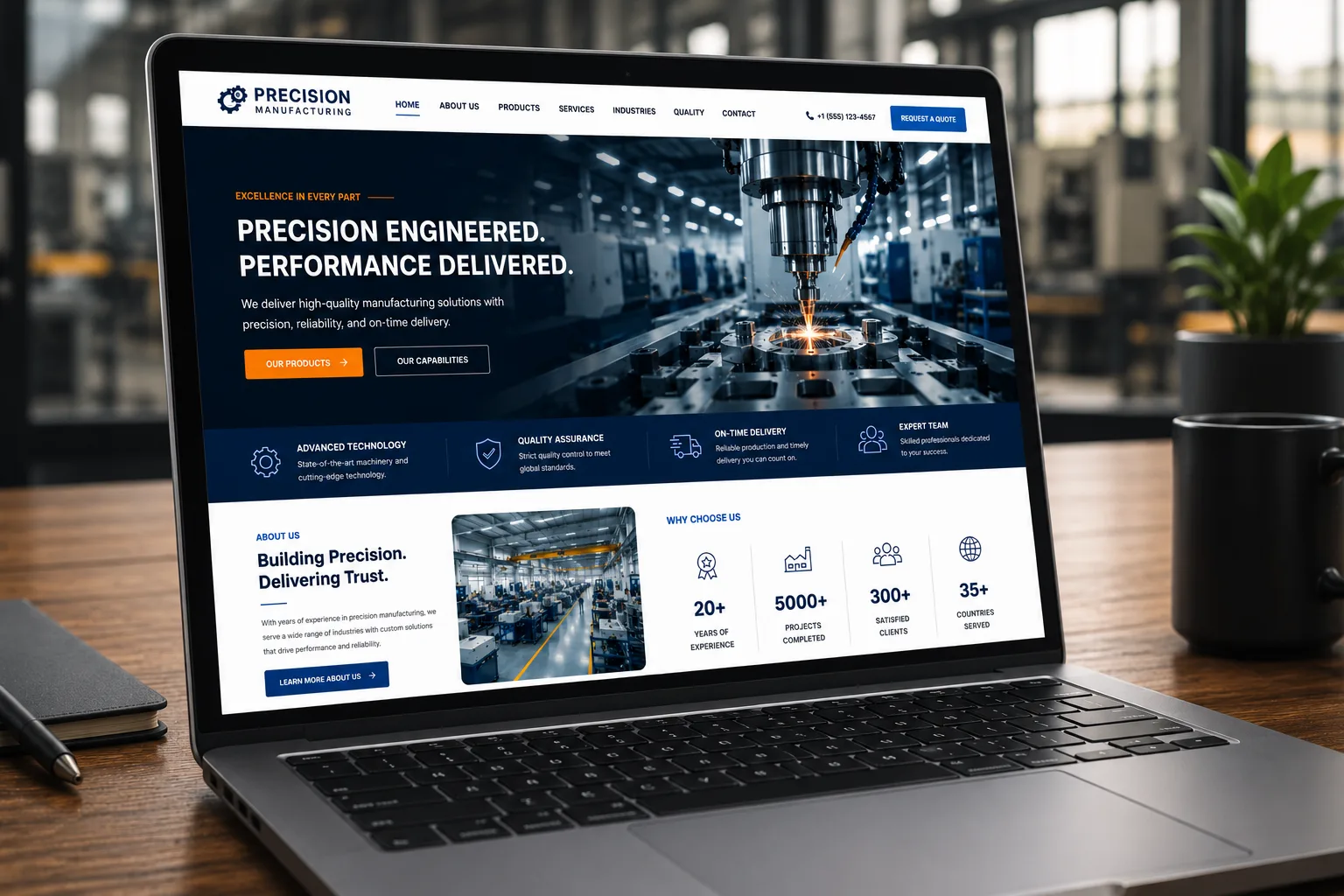
Professional photographs of your production floor showing modern machinery and organised operations communicate manufacturing competence more powerfully than any written claim. Images of quality control stations, inspection equipment, and testing facilities demonstrate commitment to quality. Clean, well-lit facility photos also simply signal that the business is professional and organised.
Short videos of manufacturing processes — showing your machines in operation, your quality checks in action, or your packaging and dispatch operations — provide the closest thing to a factory visit that remote buyers can get. For complex or precision manufacturing, a two-minute facility tour video can be the difference between a buyer adding you to their shortlist or moving on.
Real Photography, Not Stock Images
Buyers evaluating suppliers are specifically looking for evidence of your actual facility. Generic manufacturing stock photos are immediately recognisable and counterproductive — they signal that you either do not have a professional facility worth showing or that you are not confident in what you have. Real facility photography, even from a professional photographer you hire for a day, is one of the highest-return investments a manufacturer can make in their website.
Feature 4: Technical Specification Downloads
Serious buyers need technical documentation. Product data sheets, material specifications, technical drawings, test reports, and compliance certificates are often required before a procurement decision can be made. Making these documents available for download directly from your website serves buyers who need them without requiring a back-and-forth email exchange that delays the enquiry process.
Building a Document Library
A structured technical document library — organised by product category and document type — allows buyers to find and download exactly the documentation they need efficiently. Password protection for more sensitive documentation, such as detailed engineering drawings, allows you to gate access to verified contacts while making standard technical information freely available.
For manufacturers managing multiple products with frequent specification updates, a custom document management system built into your website by an experienced manufacturing software development company ensures documentation is always current and accessible without manual website updates for every revision.
Feature 5: Clear Enquiry and Contact Mechanisms
A manufacturer's website that makes it difficult to get in touch is actively costing you business. Buyers who cannot easily find how to contact you, or who encounter friction when trying to initiate an enquiry, move on to the next supplier.
Multiple Contact Options for Different Buyer Preferences
Different buyers prefer different contact methods. Some will pick up the phone immediately. Others prefer to send a detailed email. Many now prefer WhatsApp for quick initial contact. International buyers may prefer a contact form that allows them to provide detailed requirements without navigating time zone differences.
Your website should offer all of these options clearly and consistently — a prominent phone number on every page, a WhatsApp contact button, a detailed enquiry form for specifying product requirements, and email addresses for relevant departments.
Enquiry Forms Designed for Manufacturing Enquiries
Generic contact forms — "Name, Email, Message" — are not designed for manufacturing enquiries where buyers need to specify product requirements, quantities, delivery locations, and timeline. A custom enquiry form that captures the specific information your sales team needs to respond intelligently — product category, specifications, quantity required, delivery state, timeline — produces better leads and faster response times.
Feature 6: Industry and Application Pages
Buyers often search by industry rather than product. A hospital administrator searching for surgical instrument suppliers searches by industry. A food processing company looking for packaging machinery searches by application. An automotive component buyer searches by vehicle type or production system.
Creating Industry-Specific Landing Pages
Dedicated pages for each major industry you serve — automotive, pharmaceuticals, food and beverage, construction, textiles, electronics, agriculture — allow your website to appear in industry-specific searches and to communicate your experience and expertise in that specific context.
These pages should explain the specific requirements of that industry, how your products meet them, any industry-specific certifications you hold, and examples of clients you have served in that sector (with appropriate confidentiality where required).
Application Pages for Complex Products
For manufacturers producing components or materials used in multiple applications, application-specific pages perform a similar function — showing how your product is used in a specific context, what performance characteristics matter for that application, and how your product meets them.
Feature 7: Client and Project References
For B2B manufacturing businesses, client references are among the most powerful trust signals available. A list of recognisable client names — or better, specific case studies showing the manufacturing challenge and how you solved it — dramatically increases buyer confidence.
How to Present References Appropriately
Many manufacturing businesses have confidentiality agreements that prevent them from naming specific clients publicly. Where this is the case, describing the scale and type of client — "a major domestic automotive OEM," "a European multinational food company" — communicates credibility without breaching confidentiality.
Where clients are willing to be referenced publicly, their logos displayed on your website carry significant weight. A case study format — specific challenge, your manufacturing solution, measurable outcome — is even more compelling than a logo alone.
Feature 8: Export Capabilities and Global Reach
For manufacturers serving or targeting export markets, a dedicated section communicating export capabilities, compliance with international standards, packaging for export, logistics experience, and countries currently served is an important conversion factor for international buyers.
What Export Buyers Specifically Look For
International buyers evaluating Indian manufacturers want to know: can this supplier actually export reliably? This includes export documentation experience, compliance with destination country regulatory requirements, packaging suitable for long-distance shipping, experience with specific shipping terms (FOB, CIF, etc.), and any global certifications that make cross-border procurement smoother.
Communicating this capability explicitly — rather than leaving international buyers to assume you may not be export-ready — directly increases the enquiry rate from non-Indian buyers.
Feature 9: Mobile-Optimised, Fast-Loading Performance
Manufacturing websites are increasingly accessed on mobile devices — by buyers browsing at trade exhibitions, procurement teams working away from their desks, or international buyers in different environments. A website that loads slowly or displays poorly on mobile fails these users at precisely the moments when they are most likely to be actively comparing suppliers.
Performance Standards for Manufacturing Websites
Page loading time of under three seconds on mobile is the standard that keeps buyers engaged. Product images optimised for fast loading — without losing the visual quality that makes facility and product photography compelling — are essential. Technical document downloads must be efficient, not ten-megabyte PDF files that time out on slow connections.
An experienced manufacturing web app and software development partner builds these performance standards into the website architecture from the start rather than treating them as afterthoughts.
Feature 10: SEO-Optimised Structure for Search Visibility
The best-designed manufacturing website delivers no value if it cannot be found by the buyers searching for what you make. Search engine optimisation for manufacturing websites has specific requirements that distinguish it from general website SEO.
Manufacturing-Specific SEO Considerations
Buyers search for manufacturing suppliers using technical language — product names, specification terms, process names, material types, industry standards. Your website content needs to include the specific terminology your buyers use in their searches, not just the general language your internal team uses to describe what you do.
Location-based optimisation matters for manufacturers targeting regional buyers — "sheet metal fabrication Pune," "plastic injection moulding Chennai," "textile manufacturer Coimbatore" — and these location references need to be present in the right places across the website structure for local search visibility to work.
Structured data markup — schema that tells search engines your business is a manufacturer, what products you make, where you are located, and what certifications you hold — improves how your website appears in search results and can produce rich results that stand out from generic listings.
Frequently Asked Questions
1. Why does a manufacturing company need a professional website if they already get business through referrals?
Referral business is valuable but limited — it only reaches people already connected to your existing network. A professional website extends your reach to buyers who would never have encountered you through referrals: international buyers, buyers in new geographic markets, buyers conducting supplier searches through Google, and buyers who need to verify your credibility before initiating a referral-triggered conversation. In an increasingly competitive manufacturing environment, limiting yourself to referral business means leaving significant revenue opportunity unaddressed.
2. What is the most important feature for a manufacturing company website to generate B2B leads?
Clear, specific communication of manufacturing capabilities — supported by real facility photographs and complete product specifications — is the most important feature for generating B2B leads. Buyers cannot enquire about a product they cannot adequately evaluate from your website. The combination of detailed product information, quality certifications displayed prominently, technical documentation available for download, and a well-designed enquiry form creates the conditions for buyers to take the next step.
3. How often should a manufacturing company update its website?
At minimum, manufacturing websites should be updated whenever product offerings change, when new certifications are obtained or existing ones are renewed, when new client references or case studies can be added, and when facility or capacity changes occur that buyers should know about. A blog or news section updated monthly keeps the website fresh for search engines and gives buyers reasons to return. Technical documentation libraries should be updated whenever specifications change rather than on a fixed schedule.
4. Should a manufacturing website focus more on domestic buyers or international buyers?
The answer depends on your actual business mix and growth priorities. If you are targeting both, the website can serve both by including an export capabilities section alongside domestic market content, and by ensuring international standards and certifications are prominently displayed. If your primary focus is domestic, local SEO optimisation for the regions you serve should be prioritised. If export business is the primary goal, international certification compliance, export experience, and content in relevant international languages become more important.
5. What is the difference between a standard website and custom software for a manufacturing company?
A standard website presents information about your business, products, and capabilities — it is primarily a communication and lead-generation tool. Custom software for a manufacturing company goes further — it can include integrated inquiry management systems that track leads through your sales pipeline, customer portals where buyers can check order status, product configuration tools that allow buyers to specify custom requirements online, integrated inventory or production tracking, and technical document management systems. Many successful manufacturing businesses have a public-facing website for lead generation and custom software behind the scenes managing operational processes — often integrated so that enquiries from the website flow directly into the business management system.
Conclusion
A manufacturing company website with the right features is one of the highest-return business investments a manufacturer can make. Clear capability communication, professional facility photography, prominent quality certifications, downloadable technical documentation, industry-specific pages, and a fast, mobile-friendly experience — together, these features create the credibility and accessibility that convert serious buyers from searchers into enquiries.
The manufacturers winning new business in 2026 are those who have made their website work as an active business development tool — not a passive online presence that simply confirms the business exists. Every feature described in this guide contributes to that active role, turning your website into a capable, always-on member of your business development team that reaches buyers no referral network or trade exhibition can match.
Explore our manufacturing software and web development services to learn how we help Indian manufacturing businesses build websites and digital platforms that generate real enquiries, support business development, and grow their customer reach.