
How to Build a Healthcare Web Application in 2026
In 2026, a professional healthcare website is no longer optional for doctors, clinics, hospitals, diagnostic centres, or any healthcare business.
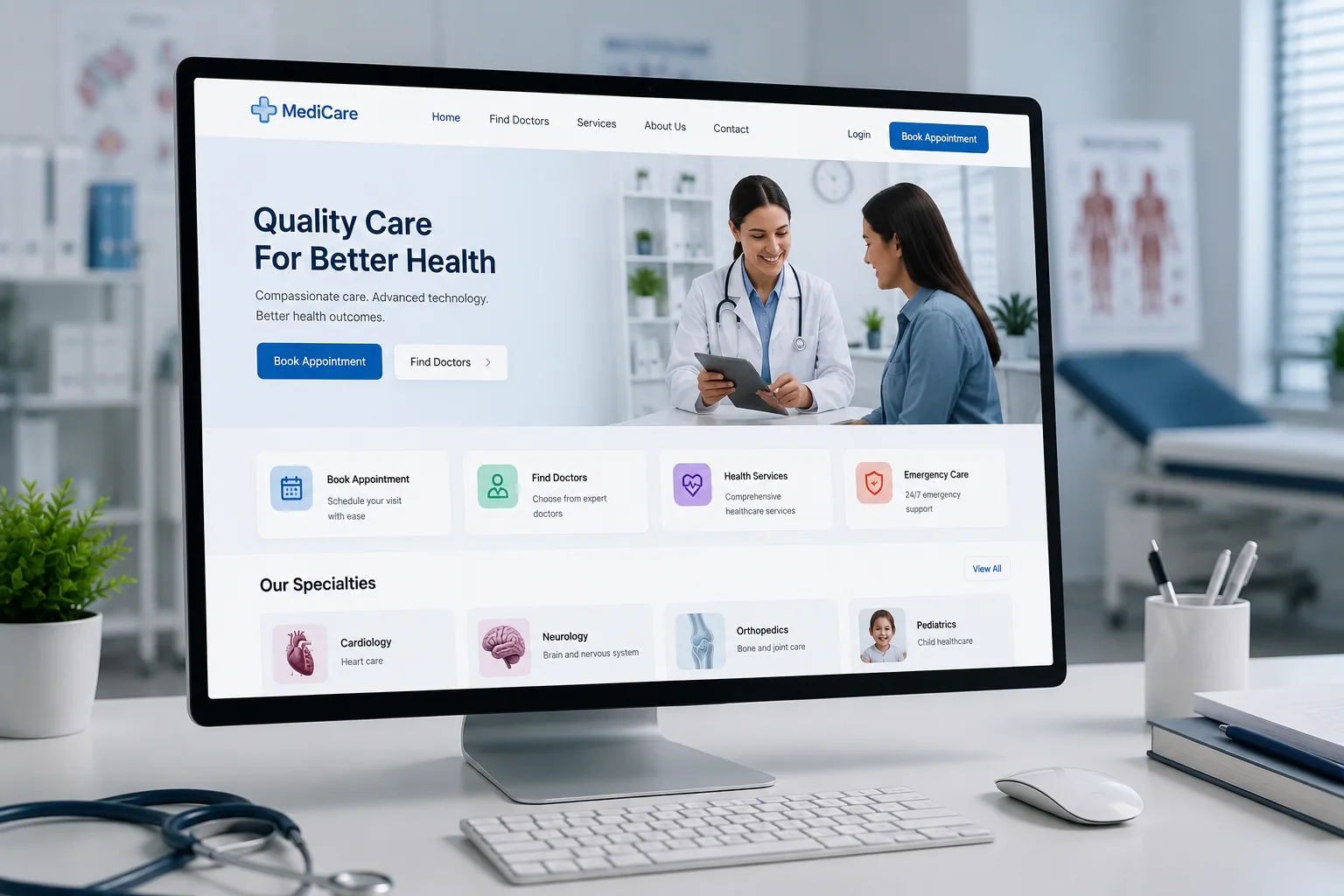
In 2026, a professional healthcare website is no longer optional for doctors, clinics, hospitals, diagnostic centres, or any healthcare business. Patients today search for healthcare providers online before they ever pick up a phone. They read reviews, check service pages, look at doctor profiles, and book appointments — all from their smartphones. If your healthcare practice doesn't have a well-built website, you are invisible to a massive and growing segment of patients.
This complete guide walks you through exactly how to build a healthcare web application that attracts patients, builds trust, and grows your practice — covering everything from planning and design to features, compliance, and launch.
Why Every Healthcare Provider Needs a Strong Website in 2026
Patients Search Online First
Before booking an appointment with any doctor or clinic, the majority of patients in India now search online. They look for proximity, specialisation, reviews, and credibility signals — all available on a well-built website. A healthcare provider without a website loses these patients to competitors who do have one.
Your Website Is Your First Impression
For most new patients, your website is the very first interaction they have with your practice. A professional, well-designed healthcare website communicates trust, competence, and credibility before a single word is spoken. A poorly built or outdated site creates the opposite impression — patients move on.
24/7 Patient Acquisition
A healthcare website works for your practice around the clock. Patients can discover your services, read about your doctors, and book appointments at midnight, on weekends, or during holidays — without requiring any staff effort. This always-on presence is something no physical clinic can replicate.
Competing in a Digital-First Healthcare Market
Larger hospital chains and healthcare networks invest heavily in digital presence. Independent clinics, specialist doctors, and smaller healthcare businesses that build strong websites can compete for patient attention effectively, regardless of their size.
Step 1: Define What Your Healthcare Website Needs to Achieve
Before any design or development work begins, clarity about your goals is essential. Different healthcare providers need different websites, and understanding your specific purpose shapes every decision that follows.
Common Healthcare Website Goals
Attracting new patients in your local area through search engines
Allowing patients to book appointments online without calling
Showcasing doctor profiles, qualifications, and specialisations
Providing health information and educational content that builds authority
Enabling patients to access reports, prescriptions, or records online
Building brand credibility and trust for a new or growing practice
Supporting multiple clinic locations under one unified digital presence
Who Are Your Patients?
Understanding your patient demographics — age range, digital comfort level, primary device used, common health concerns, and geographic location — shapes design choices, content tone, and which features matter most for your specific audience.
Step 2: Plan Your Healthcare Website Structure
Core Pages Every Healthcare Website Needs
Home Page
Your home page must immediately communicate who you are, what you treat, where you are located, and how to get in touch or book an appointment. Visitors should understand your practice within seconds of landing on the page.
About Us Page
Patients want to know who they will be seeing. A compelling about page that covers the practice's history, philosophy, values, and team builds personal connection before the first visit.
Doctor and Specialist Profiles
Individual profile pages for each doctor — including qualifications, experience, specialisations, memberships, and a professional photograph — are among the most visited pages on any healthcare website. Patients research doctors specifically before booking.
Services and Treatments Pages
Dedicated pages for each service, specialty, or treatment area you offer help patients understand whether you treat their specific condition and improve your visibility in search engines for condition-specific searches.
Appointment Booking Page
A clear, accessible appointment booking option — whether an online booking form, a prominent phone number, or a full online scheduling system — must be easy to find from every page.
Patient Information Page
Practical information patients need before visiting — clinic hours, accepted insurance providers, what to bring for a first appointment, directions and parking, and what to expect — reduces pre-appointment anxiety and unnecessary phone calls.
Blog and Health Information Section
A regularly updated blog covering health topics relevant to your specialisation attracts patients searching for health information and builds your website's authority with search engines over time.
Contact Page
A complete contact page with address, phone numbers, email, a map, and a contact form makes it easy for patients to reach you through whichever channel they prefer.
Step 3: Essential Features for a Healthcare Website
A healthcare website needs more than static information pages. The right features transform a digital brochure into an active patient acquisition and service tool.
Online Appointment Booking
The single most impactful feature for most healthcare websites is online appointment booking. Patients increasingly prefer booking online over calling, particularly outside office hours. A booking system that shows real-time doctor availability, allows patients to select preferred doctors and time slots, and sends automatic confirmation and reminder notifications reduces no-shows and makes appointment management significantly more efficient.
Doctor Search and Filter
For multi-doctor practices or hospital websites, allowing patients to search for doctors by specialisation, location, gender, language spoken, or availability helps them find the right match quickly — improving both user experience and appointment conversion rates.
Patient Login Portal
A secure patient login area where patients can view their appointment history, access past prescriptions or referral letters, download lab reports, and update their personal health information adds significant value for returning patients and reduces administrative workload for clinic staff.
Teleconsultation Booking
In 2026, offering video consultation as an option alongside in-person appointments is a meaningful differentiator. A teleconsultation booking feature with integrated video calling capability expands your practice's geographic reach and serves patients who genuinely prefer remote consultations.
Symptom Checker or Health Guides
Interactive symptom checkers or downloadable health guides relevant to your specialisation attract health-conscious visitors who may become patients while demonstrating clinical expertise that builds trust.
Reviews and Testimonials Display
Displaying verified patient reviews prominently — with schema markup that shows star ratings in search results — builds social proof and significantly influences new patient decision-making. Integrating with Google Reviews or a similar verified review system adds credibility.
Live Chat or WhatsApp Integration
Many patients prefer asking quick questions through chat before committing to an appointment. A live chat widget or WhatsApp integration provides a low-barrier first point of contact that can convert curious visitors into booked patients.
Multi-Location Support
For healthcare businesses operating across multiple clinic locations, a properly structured multi-location website with dedicated pages, Google Maps integration, and location-specific contact information for each branch improves both user experience and local search visibility for each location separately.
Health Blog with Content Management
A content management system allowing your team to regularly publish blog articles, health tips, condition guides, and practice news without requiring developer involvement keeps the website fresh and supports ongoing SEO growth.
Step 4: Design Principles Specific to Healthcare Websites
Healthcare website design has unique requirements that differ significantly from e-commerce, hospitality, or other industries. The stakes are higher — patients are making decisions about their health and wellbeing based on what they see.
Trust Is the Primary Design Goal
Every design decision on a healthcare website should be evaluated against whether it builds or undermines trust. Clean layouts, professional photography of real doctors and facilities, visible credentials and certifications, and clear contact information all contribute to a trustworthy impression.
Avoid Generic Stock Photography
One of the most common mistakes on healthcare websites is using generic stock photos — the same images of smiling nurses and stethoscopes that appear on countless other sites. Real photographs of your actual clinic, doctors, and staff are significantly more effective at building genuine patient trust.
Accessibility Matters More Than Average
Healthcare websites serve patients of all ages, including older adults who may have reduced vision, hearing, or digital literacy. Adequate font sizes, sufficient colour contrast, clear navigation labels, and mobile-friendly layouts are not optional extras — they are essential for serving your actual patient population.
Calming and Reassuring Colour Palette
Healthcare website colour choices should convey cleanliness, professionalism, and calm. Blues, greens, and whites are popular for good reason — they evoke trust and cleanliness. Overly bold or unconventional colour schemes that work well in other industries can feel jarring in healthcare contexts.
Mobile-First is Non-Negotiable
The majority of health-related searches in India happen on mobile devices. A healthcare website that works poorly on a phone — small text, difficult navigation, slow loading, hard-to-tap buttons — is failing the majority of its visitors. Mobile experience must be treated as the primary design context, not a secondary adaptation.
Clear Visual Hierarchy with Easy Navigation
Patients visiting a healthcare website often have a specific, urgent goal — finding a phone number, booking an appointment, or locating a specific service. Navigation must be intuitive, contact information must be visible without scrolling, and calls to action must be prominent on every page.
Step 5: SEO and Online Visibility for Healthcare Websites
A beautifully built healthcare website that nobody can find provides no value. Search engine optimisation for healthcare websites requires specific strategies that align with how patients actually search for healthcare providers.
Local SEO Is the Highest Priority
Most patients search for healthcare providers near them — "cardiologist near me," "skin clinic in Kochi," "dental clinic Thodupuzha." Local SEO — optimising for location-specific searches — is typically the highest-return SEO activity for healthcare websites.
Key local SEO activities include:
Maintaining a complete, accurate Google Business Profile with photos and regular updates
Ensuring consistent name, address, and phone number across all online directories
Earning genuine patient reviews on Google
Creating location-specific pages for each clinic branch
Condition and Specialisation Pages
Dedicated pages for each condition you treat — "knee replacement surgery," "thyroid treatment," "paediatric care" — capture patients searching specifically for those conditions rather than just searching for generic specialist categories.
Medical Content That Answers Patient Questions
Blog content addressing the specific questions patients ask online — "what causes lower back pain," "how to prepare for a colonoscopy," "signs you need to see a cardiologist" — attracts organic traffic from patients in the information-gathering stage who may become patients if your content is helpful and builds trust.
Page Speed as a Medical Necessity
Slow-loading healthcare websites lose patients before they see a single word of content. Given that many patients search on mobile networks with varying connection quality, optimising page speed — compressing images, minimising code, using efficient hosting — directly impacts how many visitors actually engage with your content.
Step 6: Patient Data Privacy and Website Security
Healthcare websites collect sensitive personal information — patient names, contact details, health conditions, appointment requests. This responsibility demands appropriate security measures.
SSL Certificate and HTTPS
Every healthcare website must use HTTPS with a valid SSL certificate. This encrypts data transmitted between the patient's browser and your website, protecting form submissions and login sessions from interception. It is also now a basic trust signal that patients notice.
Secure Appointment and Contact Forms
Forms collecting patient information must be implemented securely — protected against spam bots, with data transmitted and stored securely, and with clear privacy notices explaining how submitted information will be used.
Privacy Policy and Data Transparency
A clear, accessible privacy policy explaining what personal information is collected, how it is used, and how patients can request deletion or correction of their data is both an ethical requirement and increasingly a legal expectation.
Secure Patient Login Areas
If your website includes a patient portal for accessing records or managing appointments, this area requires robust authentication — including option for two-factor verification — and appropriate access controls ensuring patients see only their own records.
Step 7: Content Strategy for Healthcare Websites
Content is what attracts patients from search engines, answers their questions, and builds the trust needed for them to choose your practice. A content strategy aligned with patient needs and search behaviour is essential for long-term website growth.
Doctor-Authored Health Content
Content written or reviewed by your actual doctors carries significantly more credibility than generic health information. Patient-friendly articles explaining conditions, treatments, and procedures in clear, jargon-free language establish your doctors as knowledgeable and approachable.
Video Content for Complex Topics
Short video explanations from your doctors — explaining common procedures, answering frequently asked questions, or introducing the practice — are highly engaging and help patients feel connected to your team before their first visit.
Patient Success Stories
With appropriate consent, patient testimonials and success stories are among the most powerful content types on healthcare websites. They provide social proof that is specific to your practice, resonates emotionally with prospective patients, and can be presented across multiple formats.
Regular Publishing Schedule
Search engines favour websites that publish fresh content regularly. A consistent publishing schedule — even one or two articles per month — keeps the website active, provides ongoing opportunities to rank for new search terms, and gives patients reasons to return.
Step 8: The Development Process
Choosing a Healthcare Website Development Partner
Building a healthcare website requires a development partner with specific understanding of the healthcare context — not just general web development skills. A team experienced in healthcare web app software development in India understands patient trust signals, medical content structure, appointment booking workflows, and the security requirements specific to healthcare data.
What to Expect in the Development Process
Discovery and Planning
A good development partner will spend time understanding your practice, your patients, your goals, and your competitive landscape before proposing any design or technical approach.
Wireframing and Information Architecture
Before visual design begins, the structure and navigation of the website should be mapped out — which pages exist, how they connect, where calls to action appear, and how the user journey from landing to booking flows.
Design and Brand Development
Visual design translates your brand identity into a cohesive web experience — colours, typography, photography style, component design — that communicates your practice's personality and builds patient trust.
Development and Integration
Development brings the design to life while integrating necessary functionality — appointment booking systems, patient portals, blog content management, analytics, and any third-party integrations your practice needs.
Testing Across Devices and Browsers
Before launch, comprehensive testing across mobile devices, tablets, and desktop browsers, across different screen sizes and connection speeds, ensures every patient receives an acceptable experience regardless of how they access the site.
Launch and Ongoing Support
A healthcare website launch is the beginning, not the end. Ongoing support for updates, security patches, content changes, and performance improvements keeps the website serving patients effectively over time.
Step 9: Measuring Your Healthcare Website's Performance
After launch, understanding how the website is performing — and where it can be improved — requires tracking the right metrics.
Key Metrics to Track
Organic Search Traffic
How many patients find the website through Google search, and which pages and keywords are driving this traffic.
Appointment Conversion Rate
What percentage of website visitors go on to book an appointment — and where in the journey patients are dropping off before completing a booking.
Local Search Visibility
How the website and associated Google Business Profile rank for local healthcare searches in your target area.
Page Load Speed
Regular monitoring of loading speed across mobile and desktop to catch and resolve performance issues before they affect patient experience.
Bounce Rate by Page
Which pages cause visitors to leave immediately, indicating content or experience gaps that need addressing.
Conclusion
Building a healthcare web application in 2026 means building a patient-centred digital presence that attracts, informs, and converts — a website that works as a 24-hour front desk for your practice, building trust with new patients and serving existing ones around the clock. From doctor profiles and online appointment booking to health content that ranks in search engines and patient portals that reduce administrative burden, every element of a well-built healthcare website contributes to a stronger, more accessible, and more competitive practice.
The healthcare providers who invest in building the right website today — one focused on patient needs, local search visibility, trust-building design, and genuine usability — will have a meaningful and growing advantage as patient digital behaviour continues to evolve.
If you are ready to build or significantly improve your healthcare website, our team at Vincora specialises in building healthcare web applications that attract patients and support practice growth. Get in touch to discuss your requirements and start building the online presence your practice deserves.