Top Mobile App Development Trends in the US for 2026
The US mobile app market is one of the most competitive, most innovative, and most demanding in the world. American consumers download more apps, spend more time in apps, and have higher expectations for app quality than almost any other market.
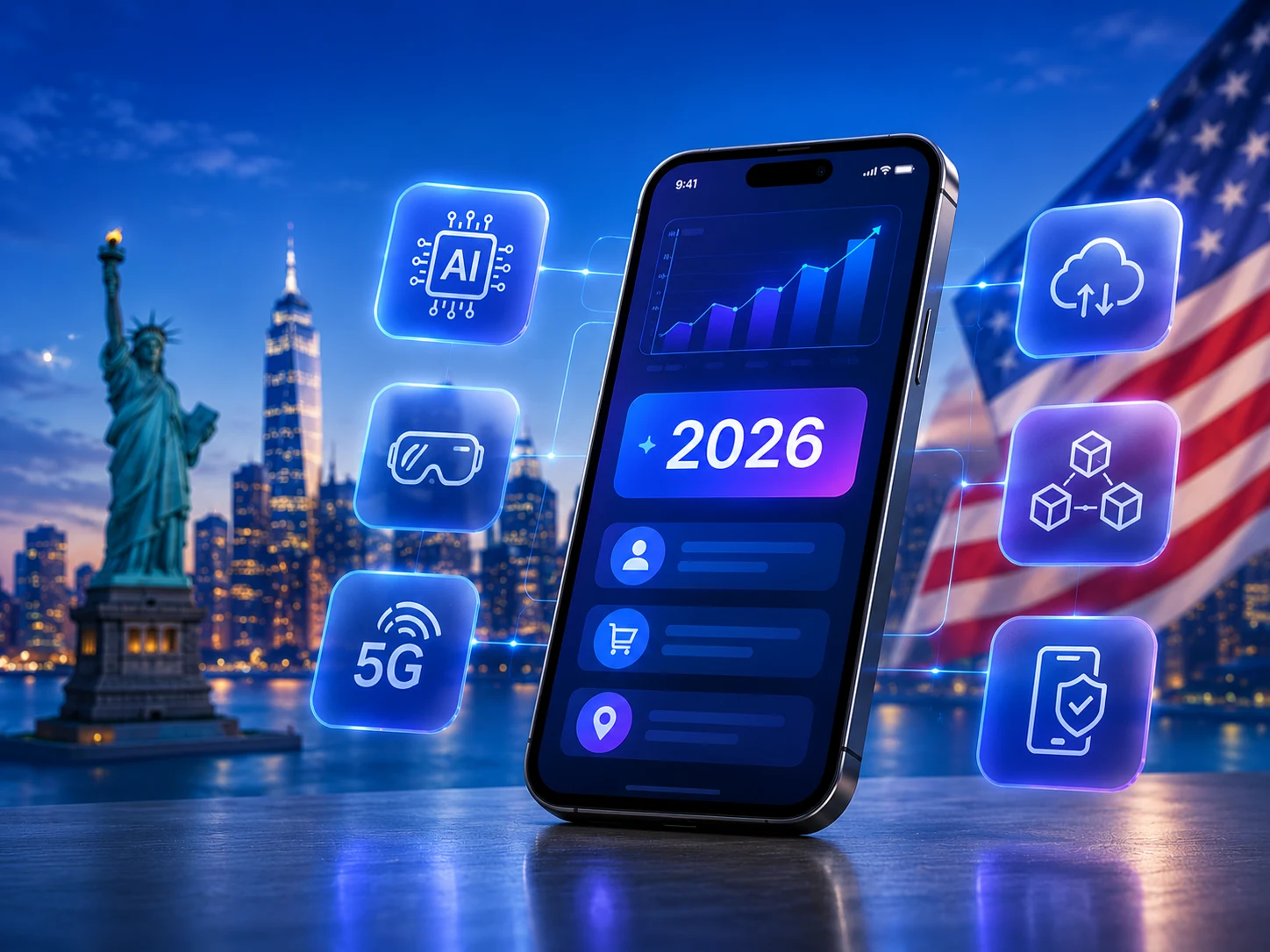
Businesses that want to succeed with mobile apps in the US in 2026 are not just competing against direct industry competitors — they are competing against every well-designed app their users interact with daily, from Netflix to Uber to Spotify.
Understanding the mobile app development trends in the US that are shaping 2026 is not optional for businesses serious about mobile. These trends are not theoretical future developments — they are the current expectations of American app users and the standards that successful apps in the US market are being built to right now. This guide covers the trends that matter most, what they mean in practice, and how US businesses and their development partners can use them to build apps that stand out.
Why the US Mobile Market Demands More Than Other Markets
The US User Quality Bar Is Exceptionally High
American app users are among the most experienced mobile users in the world. They have been using smartphones for over fifteen years. They have downloaded hundreds of apps. They know immediately what a well-built app feels like — and they have zero patience for apps that do not meet that standard.
An app that might be considered good in a less mature mobile market would be considered mediocre or unusable in the US. Loading delays that users in other markets tolerate will drive App Store reviews downward in the US. Navigation patterns that feel acceptable in other contexts will feel outdated to American users accustomed to the best-designed apps in the world.
Competition That Comes From Everywhere
US businesses building mobile apps compete not just with other businesses in their category but with the design and experience quality of the best apps across all categories. When your users open your app after closing Spotify or Google Maps, their unconscious comparison point is everything they just experienced — not just other apps in your specific industry.
This is why custom mobile app development services for the US market must treat design, performance, and user experience as primary concerns rather than secondary features.
Regulatory Environment That Shapes Development Choices
The US has a complex and evolving regulatory environment affecting mobile apps — from Apple's App Store policies and Google's Play Store requirements to federal and state regulations on data privacy (California's CCPA and CPRA), healthcare data (HIPAA), financial services (various federal regulations), and children's privacy (COPPA). Development choices that ignore these requirements create legal exposure that can be significantly more expensive than building compliance in from the start.
Trend 1: AI Integration That Goes Beyond Chatbots
Artificial intelligence has been a buzzword in mobile app development for several years. In 2026, the distinction that matters is between AI that is genuinely useful and AI that is superficially added to satisfy a trend requirement.
AI That Personalises the Core Experience
The most effective AI implementations in US apps do not add a chatbot to an otherwise unchanged app. They fundamentally change how the app presents itself to each individual user based on that user's actual behaviour patterns, preferences, and context.
A fitness app that adapts its workout suggestions to the user's actual performance over time, not just stated goals. A shopping app that learns what kinds of products a user actually buys versus what they browse without purchasing. A productivity app that notices when a user is most likely to engage deeply and schedules important content accordingly. These implementations are invisible to the user as AI — they just make the app feel remarkably well-suited to the individual using it.
On-Device AI for Privacy and Performance
Increasing numbers of US app developers are moving AI processing onto the device itself rather than sending data to cloud servers for processing. On-device AI respects user privacy by keeping data local, works without internet connectivity, and responds faster because it eliminates round-trip server latency. For US users who are increasingly privacy-conscious, on-device AI also provides a meaningful trust advantage.
Generative AI for Content and Creative Features
Generative AI capabilities — producing text, images, code, or other content on demand — are being integrated into a growing range of US apps. From AI-assisted writing in productivity apps to AI image generation in creative tools to AI-powered customer support that genuinely understands complex queries, generative AI is expanding what mobile apps can do for users in ways that would have required dedicated human effort just two years ago.
Trend 2: Super App Evolution in Specific Verticals
The super app concept — a single app that handles multiple related services rather than requiring separate apps for each — has historically been associated with Asian markets like WeChat in China and Grab in Southeast Asia. In the US, the model is emerging more gradually and within specific verticals rather than as broad lifestyle platforms.
Financial Services Super Apps
The US fintech space is producing apps that combine banking, investing, credit, insurance, and financial planning within single platforms. Users who previously needed separate apps for their bank account, investment portfolio, insurance policies, and budgeting tool are increasingly finding that a single well-designed financial app handles everything.
Healthcare Super Apps
Healthcare platforms that combine appointment booking, telehealth consultations, prescription management, lab results, health tracking, and insurance coordination are gaining adoption among American patients who want to manage their health digitally without navigating dozens of disconnected systems.
Lifestyle and Commerce Platforms
Retail apps that add loyalty programmes, social features, content, and direct brand relationships alongside shopping functionality are building the kind of everyday engagement that pure commerce apps cannot match — keeping users in the app between purchase occasions rather than only when a specific purchase need arises.
Trend 3: Privacy-First Architecture as a Competitive Advantage
Privacy was once primarily a compliance consideration for US app developers. In 2026, it is increasingly a competitive differentiator. American consumers — particularly younger demographics — actively choose apps with clear, respectful privacy practices over alternatives that exploit data aggressively.
App Tracking Transparency and Its Aftermath
Apple's App Tracking Transparency framework fundamentally changed the economics of app-based advertising in the US and forced a rethinking of how apps collect and use data. The apps that have navigated this most successfully are those that built first-party data strategies — collecting data directly from engaged users who consent clearly, rather than relying on cross-app tracking infrastructure that has been severely curtailed.
Privacy as a Design Principle
Privacy-first design means making deliberate choices about what data to collect, being transparent about why it is collected, giving users meaningful control over their data, and building technical architecture that minimises data exposure. Apps that make these choices visibly — not just in privacy policies nobody reads but in the actual interaction design — build the user trust that drives the long-term retention the US market rewards.
State-Level Compliance Complexity
California's CCPA and CPRA set requirements that effectively define minimum privacy standards for any app serving US users. But additional states have enacted their own privacy legislation with varying requirements. Building apps with privacy compliance designed from the architecture stage — rather than retrofitted before launch — is dramatically more practical and less expensive than the alternative.
Trend 4: Wearable and Cross-Device Experiences
The US has high penetration of wearable devices — Apple Watch commands a significant share of the smartwatch market, and health wearables from companies like Fitbit, Garmin, and Oura are common among health-conscious American consumers. Mobile apps that extend meaningfully onto wearables are building user relationships that phone-only apps cannot match.
Meaningful Wearable Extensions
The keyword is meaningful. Pushing all app notifications to a wearable is not a wearable strategy — it is wearable spam. The most effective wearable integrations identify what genuinely makes sense on a small screen with limited interaction capabilities: quick status updates, time-sensitive alerts, health data collection, navigation prompts, and payment authorisation.
Apps that design wearable experiences specifically for what wearables do well — rather than cramming full app functionality onto a small screen — build utility that users genuinely value and that drives long-term engagement with the broader platform.
Cross-Device Continuity
American users move between devices throughout their day — from phone in the morning to laptop at work to tablet in the evening, with a wearable throughout. Apps that provide seamless continuity across these transitions — picking up where the user left off, syncing state in real time, providing the right interface for each device without requiring manual switching — build the kind of integrated daily presence that makes apps genuinely useful rather than occasionally visited.
Trend 5: Hyper-Personalisation Powered by Behavioural Data
Personalisation in 2026 goes significantly beyond showing users their name in a greeting or remembering their last order. Hyper-personalisation uses real-time behavioural signals to continuously adapt every aspect of the app experience — content, interface, notifications, recommendations, offers — to the individual user's current context and evolving preferences.
Dynamic Content That Adapts in Real Time
Rather than a static home screen that every user sees identically, hyper-personalised apps present content dynamically adjusted to what each user is most likely to engage with at that specific moment. A user who has been browsing fitness content sees fitness-relevant recommendations. A user who primarily uses the app on weekend evenings gets different content presentation than one who uses it during weekday mornings.
Contextual Awareness Beyond Basic Profiling
The most sophisticated US apps incorporate contextual signals — time of day, location, recent in-app behaviour, external events — into personalisation decisions in real time. This contextual layer makes personalisation feel genuinely intelligent rather than just statistically correlated.
Personalised Pricing and Offers
For ecommerce and subscription apps, personalised offers — showing different promotions to different users based on their purchase history, price sensitivity signals, and engagement patterns — are becoming more sophisticated and more effective at increasing conversion and lifetime value.
Trend 6: Instant Apps and Reduced Friction Entry
The friction of downloading a new app — finding it in the app store, waiting for it to download, creating an account, completing onboarding — causes significant drop-off before users ever experience what the app offers. US app developers are increasingly addressing this friction with approaches that reduce the barrier to first meaningful use.
App Clips and Instant Apps
Apple's App Clips and Google's Instant Apps allow users to experience core app functionality without downloading the full app. A user who scans a QR code at a restaurant can access the menu and ordering functionality through an App Clip without downloading the full restaurant app. A user who clicks a link to a service can experience it immediately without a download barrier.
Progressive Onboarding That Delays Account Requirements
Requiring users to create an account before experiencing any value is one of the most common reasons new users abandon an app immediately after download. Progressive onboarding approaches that allow users to explore and experience value before asking for registration — delaying the account creation requirement until the user has seen enough to be motivated to commit — consistently improve activation rates.
Trend 7: Voice and Conversational Interfaces
Voice interaction is deeply embedded in American digital behaviour. Siri, Alexa, Google Assistant, and ChatGPT have conditioned US users to interact with technology conversationally. Mobile apps that incorporate natural voice interaction are serving a strong existing user behaviour rather than asking users to adopt a new one.
Voice as a Navigation Alternative
For apps used in contexts where visual attention is divided — driving, cooking, exercising — voice commands that trigger app functions without requiring screen interaction serve real user needs. Navigation apps have done this for years; the pattern is spreading to other app categories.
Natural Language Processing for Search
Search within apps that understands natural language queries — "show me what I ordered last Christmas" rather than requiring date filters and category selection — dramatically reduces the effort of finding information within complex apps. For US apps with large content libraries or complex product catalogues, natural language search is a meaningful UX improvement that increases the likelihood users find what they are looking for.
Trend 8: Advanced Security Architecture
US app users have been educated by years of high-profile data breaches and platform policy discussions about data privacy. Security is increasingly a factor in which apps US consumers choose and whether they grant sensitive permissions. For apps in regulated industries — healthcare, financial services, legal — robust security architecture is both a user expectation and a regulatory requirement.
Biometric Authentication as Standard
Face ID and Touch ID have made biometric authentication frictionless for US iPhone users. Apps that use biometrics for login — rather than requiring passwords for every session — provide better security alongside better user experience. For apps where security matters, biometric-only or biometric-first authentication is increasingly expected rather than optional.
Zero Trust Security Models
Enterprise-focused US apps are implementing zero trust security architectures — where no access is assumed to be safe by default, and every request is verified regardless of source. For apps handling sensitive business data, healthcare information, or financial records, zero trust architecture provides meaningful protection against the breach scenarios that make headlines.
Trend 9: Sustainable and Efficient App Development
American consumers and businesses are increasingly attentive to the environmental footprint of their digital products. App efficiency — how much battery, data, and processing resources an app consumes — is gaining attention as a quality dimension alongside performance and design.
Energy-Efficient Code as a Quality Metric
Apps that drain battery or consume excessive data generate negative reviews and increased churn among US users who notice these costs. Building energy efficiency into development — optimising background processing, minimising unnecessary network requests, using efficient algorithms — produces apps that users rate more highly and use more consistently.
Sustainable Development Practices
Development teams that adopt practices which reduce unnecessary code complexity, minimise redundant dependencies, and build for longevity rather than chasing trends produce apps with lower long-term maintenance costs alongside their environmental advantages.
Trend 10: Real-Time Features That Keep Users Engaged
Realtime functionality — live data updates, collaborative features, instant notifications, live streaming — has become a baseline expectation in many US app categories. Apps that require manual refresh or that deliver information with significant delays feel outdated compared to alternatives that show the world as it actually is right now.
Live Collaboration Features
Following the acceleration of remote work in the US, collaborative features — multiple users working simultaneously in the same app interface — have moved from enterprise tools into mainstream productivity, creative, and social apps. Building apps that multiple users can inhabit simultaneously requires specific technical architecture but delivers engagement levels that individual-use apps cannot approach.
Real-Time Social Proof and Activity
Showing users what is happening right now — how many people are looking at a product, what friends have done recently in the app, live event participation counts — creates the sense of live, shared experience that drives engagement and reduces the isolated feeling that many solo app experiences create.
Choosing a Development Partner for US Market App Development
Building apps that meet these 2026 US market standards requires more than technical capability. It requires genuine understanding of American user expectations, the US regulatory environment, App Store optimisation for the US market, and the competitive dynamics of the specific category the app is entering.
When evaluating custom mobile app development services for the US market, look for:
Portfolio of apps that have performed well specifically in the US market — not just technically functional apps
Understanding of US App Store review guidelines and optimisation strategies
Familiarity with relevant US regulations — CCPA, HIPAA, COPPA, or others specific to your industry
Experience with the specific AI, cross-device, or security capabilities your app requires
A development process that treats performance, privacy, and design quality as first-class requirements from day one
Frequently Asked Questions
1. What is the most important mobile app development trend for US businesses to focus on in 2026?
AI integration and privacy-first architecture are the two trends with the broadest commercial impact across the widest range of US app categories. AI that genuinely personalises the user experience drives retention and lifetime value. Privacy-first design builds the user trust that the US market increasingly rewards. For businesses with limited development budget to apply across all trends, prioritising these two delivers the highest return for most app categories.
2. How much does it cost to build a mobile app that incorporates these 2026 trends for the US market?
App development cost depends primarily on scope and complexity rather than which trends are incorporated. Some trends — like privacy-first architecture and progressive onboarding — are design and process choices that do not significantly increase development cost. Others — like sophisticated AI personalisation, real-time collaboration, or wearable integration — require meaningful additional development investment.
3. Should a US app be built natively for iOS and Android or using a cross-platform framework?
The US market tilts more toward iOS than most global markets — Apple's US market share is significantly higher than its global average — but Android remains important for comprehensive US market coverage. For most business apps that are not pushing the absolute limits of device hardware, modern cross-platform frameworks deliver results that US users experience as native-quality while reducing development cost and timeline.
4. How do US App Store review guidelines affect what can be built?
Apple's App Store guidelines affect every iOS app targeting US users significantly. They govern what functionality is permitted, how subscriptions and in-app purchases must be implemented, what data can be collected and how it must be disclosed, how advertising must be handled, what content is acceptable, and many other aspects of app design and business model.
5. How does data privacy regulation in the US affect mobile app development choices?
US data privacy regulation — primarily California's CCPA and CPRA but increasingly laws in other states — affects mobile apps in several ways. Apps must provide clear disclosure of what data is collected and how it is used. Users must be able to opt out of data sales and sharing. Users must be able to request deletion of their data. Apps targeting California residents — which effectively means most apps targeting US users generally — must comply regardless of where the app company is based.
Conclusion
The mobile app development trends in the US for 2026 reflect a market that rewards genuine quality, respects user privacy, leverages AI meaningfully, and expects experiences that feel tailored to the individual rather than designed for the average. Businesses building US market apps that incorporate these trends thoughtfully — not as checkboxes but as genuine improvements to the user experience and business outcomes the app delivers — are building competitive advantages that compounds over time.
The US mobile market is simultaneously the most demanding and the most rewarding. Apps that earn the loyalty of American users through quality, personalisation, and respect for their time and privacy are apps that generate the kind of long-term engagement and business value that justify the investment in getting them right.
If you are building or scaling a mobile app for the US market and want to work with a development team that understands what US users expect and how to build to those standards, explore our custom mobile app development services for the US and get in touch to discuss your project.