ERP vs CRM vs Custom Software: What Does Your Business Actually Need?
If you have been researching business software, you have almost certainly come across three terms that get thrown around constantly — ERP, CRM, and custom software.
Each one promises to solve business problems. Each one comes with its own price tag, its own learning curve, and its own set of advocates who will tell you it is exactly what you need.
But here is the honest question nobody seems to answer directly: which one does your business actually need?
This guide cuts through the confusion. We will explain what each option actually does in plain language, show you exactly who it is right for, and give you a clear framework for making the decision that fits your specific business — not someone else's.
First, Why This Decision Matters So Much
Choosing the wrong business software is expensive in ways that go beyond the purchase price.
You spend months implementing a system, training your team, and migrating your data — only to discover the software does not quite fit how your business works. Your team works around its limitations rather than with its capabilities. The productivity gains you expected never materialise. A year later you are evaluating alternatives and starting the process again.
This happens to businesses of every size, across every industry. The root cause is almost always the same: the software was chosen based on what it does, not on whether what it does matches what the business actually needs.
So before comparing ERP, CRM, and custom software, we need to answer a simpler question first.
What Problem Are You Actually Trying to Solve?
Business software exists to solve business problems. Before evaluating any technology, get specific about what your problem actually is. Here are the most common categories:
Are customers falling through the cracks?
Leads not followed up, existing customers not contacted, sales pipeline invisible to management, customer history scattered across multiple people's memories and spreadsheets?
Are your internal operations inefficient?
Orders getting lost, inventory miscounted, invoicing delayed, departments not sharing information, management unable to see what is actually happening across the business?
Do you have processes that are genuinely unique to how your business works?
Things that off-the-shelf software simply does not accommodate because they are specific to your business model, your industry, or your competitive approach?
Your answer to these questions points toward the right category of solution. Now let us understand what each one actually is.
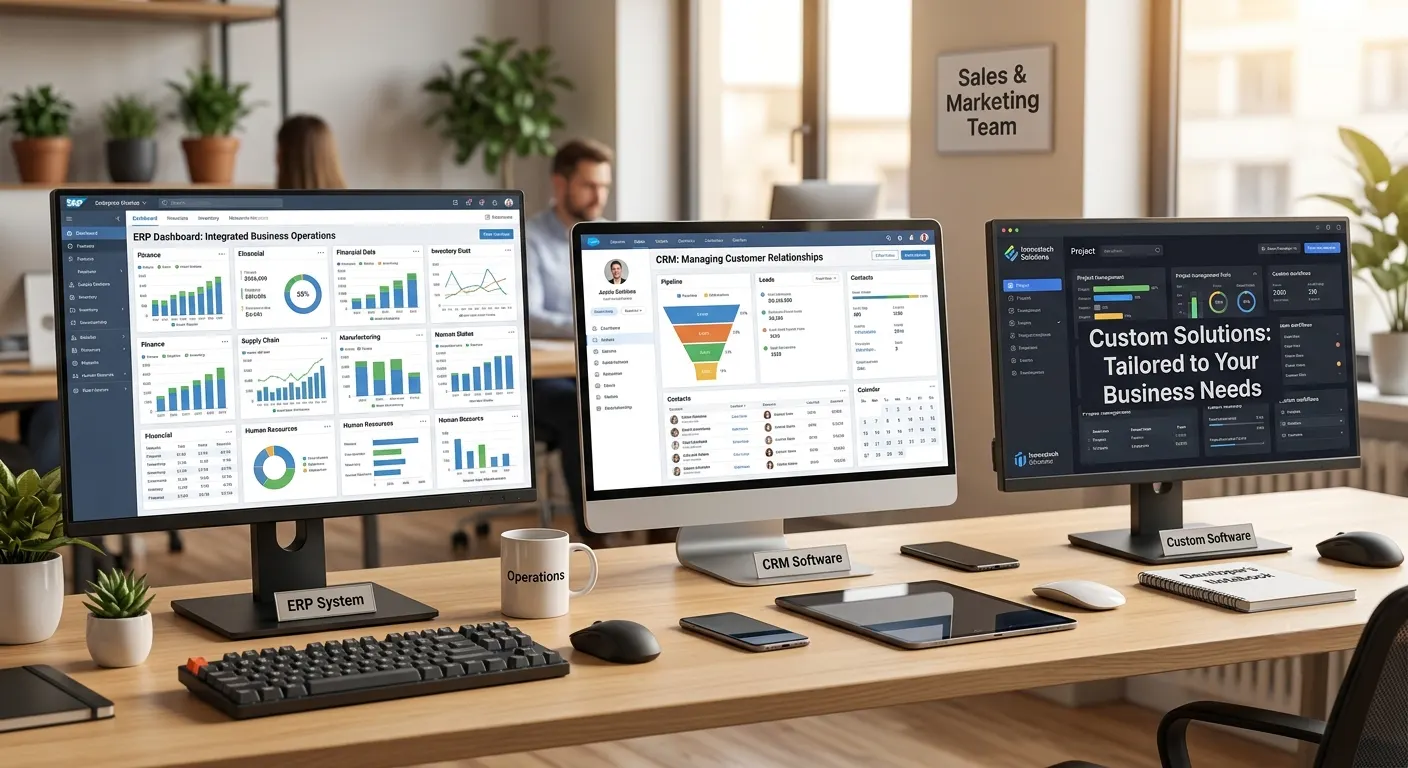
What Is a CRM?
CRM stands for Customer Relationship Management. Despite the technical-sounding name, the concept is straightforward.
A CRM is a system that helps you manage your relationships with customers and potential customers. It keeps track of every person your business interacts with — their contact details, their history with your business, where they are in your sales process, what conversations have happened, and what needs to happen next.
What a CRM Actually Does Day to Day
Think of a CRM as your business's memory for customer relationships. Without one, this memory lives in salespeople's heads, in WhatsApp chats, in email threads, and in spreadsheets that three different people maintain differently. When a salesperson leaves, that memory walks out the door with them.
A CRM centralises all of this:
Every lead that comes in is captured and tracked
Every interaction — call, email, meeting, WhatsApp message — is logged against the relevant contact
The sales pipeline is visible to everyone who needs to see it
Follow-up tasks are assigned and tracked so nothing gets forgotten
Customer service history is accessible so every team member can see what has already been discussed
Who Actually Needs a CRM
A CRM makes sense when your business's primary problem is customer-related — leads not converting, customers not being retained, management not knowing what the sales team is doing, or customer service quality suffering because history is not accessible.
Businesses that benefit most from CRM implementation tend to share common characteristics: they have meaningful sales processes with multiple steps, they deal with repeat customers whose history matters, and their revenue is directly tied to how well they manage ongoing relationships.
This includes professional service firms, real estate agencies, healthcare practices managing patient relationships, B2B companies with long sales cycles, educational institutions managing student enquiries, and retail businesses building loyalty with regular customers.
What a CRM Does Not Do
A CRM is not an operations tool. It does not manage your inventory, your suppliers, your production processes, your accounting, or your internal workflows. If your problem is operational rather than customer-relationship-focused, a CRM will not fix it.
What Is an ERP?
ERP stands for Enterprise Resource Planning. This one genuinely sounds more intimidating than it needs to be. Strip away the jargon and an ERP is a system that connects the different operational departments of a business into a single unified platform.
Where a CRM focuses on the customer-facing side of business, an ERP focuses on the operational backbone — everything that happens inside the business to deliver products or services.
What an ERP Actually Does Day to Day
An ERP connects functions that typically operate in silos:
Inventory and warehouse management — tracking stock levels in real time, managing procurement from suppliers, handling goods received and dispatched.
Finance and accounting — purchase orders, sales invoices, expense management, financial reporting, tax compliance.
Manufacturing and production — production scheduling, bill of materials, work-in-progress tracking, quality control.
Human resources — employee records, payroll, attendance, leave management.
Procurement and supply chain — supplier management, purchase order processing, goods receipt, supplier payment.
The key value of an ERP is integration. When a sale is made, the inventory automatically decrements. When a purchase order is created, the accounting system is automatically updated. When production uses raw materials, the warehouse knows immediately. Information flows across the business automatically rather than requiring manual transfer between disconnected systems.
Who Actually Needs an ERP
ERP makes sense for businesses that have become operationally complex — typically manufacturers, distributors, larger retailers, or businesses with multiple departments that need to share operational information in real time.
The clearest signal that a business is ready for ERP is when the manual effort of keeping disconnected systems synchronised has become a significant operational problem. Multiple people spending significant time reconciling data between spreadsheets, inventory mismatches causing fulfilment problems, finance not knowing what operations has committed to suppliers — these are ERP problems.
What an ERP Does Not Do (Well)
ERP systems are powerful but they come with trade-offs. They are complex to implement, they are expensive, they require significant training, and they are designed around standard business processes that may or may not match how your specific business works.
Many businesses implement ERPs and then spend years trying to make their operations conform to how the ERP expects business to work — rather than having software that conforms to how their business actually works. This is the core limitation that brings us to the third option.
What Is Custom Software?
Custom software is exactly what it sounds like — software built specifically for your business, designed around your actual processes, your actual workflows, and your actual requirements.
Where ERP and CRM are standard products adapted to your business with configuration, custom software starts with your business and builds software around it. There is no predetermined structure to conform to. Every feature, every screen, every workflow, every report is designed for how your business specifically operates.
What Custom Software Actually Does
Custom software can do anything — which sounds like an obvious statement but it is actually the key insight. CRM and ERP are categories with defined scopes. Custom software has no predefined scope. It solves the problems you define in the way that makes sense for your specific business.
This could be:
A client management system that works exactly like your service delivery process works — not a generic client management model
An order management system that integrates your specific order types, your specific pricing logic, and your specific fulfilment workflow
An internal operations tool that automates the specific manual processes that are consuming your team's time
A customer-facing portal that serves your customers exactly the way your business model requires, not the way generic portal software assumes
A system that bridges multiple functions — some CRM-like, some ERP-like, some unique to your business — in a single coherent platform
Who Actually Needs Custom Software
Custom software is the right choice when standard products consistently fall short of what your business actually needs.
The clearest indicators are:
Your business processes are genuinely different from industry standard. If your competitors all use the same off-the-shelf CRM or ERP and it fits them but not you, that gap is probably because your business works differently in ways that represent a real competitive advantage — and generic software cannot accommodate that difference.
You have evaluated standard products and keep finding that critical requirements are missing or require expensive workarounds. This is not a negotiation with the software — it is the software telling you it was not built for your use case.
You need integrations that standard products do not support. Your business relies on specific tools, equipment, or data sources that generic software vendors have never built integrations for.
You need features that are genuinely unique to your business model. The way you price, the way you deliver, the way you manage relationships, or the way you operate does not fit standard templates.
Comparing the Three Options Directly
Cost Structure
CRM software is typically the most accessible — subscription-based pricing means lower initial investment, though costs scale with users and features over time.
ERP implementation is significantly more expensive — not just in licensing but in implementation consulting, data migration, training, and the extended timeline required to get a complex system operational.
Custom software requires upfront development investment but has no ongoing licensing fees and no per-user costs. The total cost of ownership over a three to five year period frequently compares favourably to ERP for businesses that genuinely need custom solutions rather than standard ones.
Implementation Timeline
CRM can often be operational within weeks. The core functionality is predefined; the effort is configuration, data import, and user adoption.
ERP implementations take months to a year or more for complex organisations. The integration of multiple departments, the data migration requirements, and the process change management involved make ERP the longest implementation journey.
Custom software timelines depend entirely on scope. A focused custom solution addressing specific processes can be delivered in weeks. A comprehensive custom platform replacing multiple systems requires longer.
Flexibility
CRM and ERP flexibility is bounded by what the software vendor has built. You can configure within their parameters, but you cannot make the software do something it was not designed to do.
Custom software has no such boundary. If your business needs change, the software changes with them. New features, new integrations, new workflows — all achievable because the development team built the software and can extend it.
User Adoption
This is the factor that most businesses underestimate before implementation. User adoption — whether the people who need to use the software actually do — is the most important determinant of whether any software investment delivers its promised value.
CRM adoption tends to be relatively straightforward for user-facing functions. People can see the direct personal benefit of having customer history centralised.
ERP adoption is notoriously difficult. The complexity of the system, the extent of process change it requires, and the perceived administrative burden of feeding data into it create genuine resistance that derails many ERP implementations.
Custom software — when designed with user workflows at the centre — typically achieves the best adoption rates. Software built around how people actually work feels intuitive rather than imposed. Users see their specific tasks reflected in the interface rather than having to understand a generic model to accomplish their goals.
A Practical Decision Framework
Rather than thinking about the category first, start with your specific situation:
Your biggest problem is losing customers and revenue opportunities
If leads are not being followed up, existing customers are not being retained, your sales team has no visibility of a shared pipeline, or customer service is suffering because history is not accessible — start with a CRM. It addresses the specific problem directly without unnecessary complexity.
Your biggest problem is operational chaos as you grow
If inventory is consistently inaccurate, finance does not know what operations has committed, different departments are working from different versions of truth, or the manual effort of keeping systems synchronised is becoming unsustainable — an ERP addresses operational integration. But evaluate carefully whether a standard ERP's processes match your actual processes before committing.
Your business has unique processes that standard software consistently misses
If you have evaluated CRM and ERP options and found them consistently falling short because your business works in ways they do not accommodate — custom software is not the expensive option; it is the one that will actually work.
You need both customer management and operational integration, but standard products do not fit your specific version of either
Custom software that bridges both domains — designed around your specific customer management and your specific operational reality — is often more practical than implementing both a CRM and an ERP and trying to integrate them.
Common Mistakes to Avoid
Choosing based on what competitors use
Your competitors' software choices reflect their specific situation — their processes, their team size, their budget, their technical infrastructure. What works for them may be wrong for you even if you are in the same industry.
Letting the vendor drive the decision
Software vendors have strong incentives to sell you their specific product. A vendor selling CRM will show you why CRM is what you need. A vendor selling ERP will show you why ERP is what you need. Getting independent advice — from a development partner with no stake in any specific product category — produces better decisions.
Underestimating implementation effort
Every software implementation requires more effort than the vendor's sales process suggests. Budget for training, process change, data migration, and the productivity dip that accompanies any major software change.
Treating it as a one-time decision
Your business will change. The software that is right for you today may not be the right software in three years. Choosing solutions with good scalability and flexibility — or building custom software with extensibility in mind from the start — protects your investment against the need to start over when your business outgrows your initial choice.
Where Vincora Fits In
At Vincora, we work with businesses across Kerala and India to build the right technology solutions for their specific situations — whether that means advising on the right standard product, implementing a CRM or business management tool that fits your processes, or building custom software that does what off-the-shelf options cannot.
We do not have a product to sell. We have the capability to build what your business actually needs — which means our advice starts with understanding your business, not with fitting your business into a product we happen to offer.
Explore what we build at Vincora and get in touch to discuss what your business actually needs — whether that is a CRM that finally gets used, an operational system that fits your specific processes, or custom software that gives you a capability no competitor has.
Conclusion
ERP vs CRM vs custom software is not a question with a universal right answer. It is a question that only has the right answer for your specific business, your specific problems, and your specific growth ambitions.
CRM is right when your biggest problem is customer relationship management — losing leads, missing follow-ups, or having no visibility of your sales pipeline.
ERP is right when your biggest problem is operational integration — departments working in silos, inventory inaccuracies, or the manual effort of keeping disconnected systems synchronised becoming unsustainable.
Custom software is right when standard products consistently fall short — because your business works in ways they were not designed to accommodate, because your processes are genuinely unique, or because you need capabilities that off-the-shelf solutions simply do not provide.
The most important thing is to start with your problem, not with a category. Understand exactly what is costing your business time, money, and growth — and then find the solution that addresses that specific problem most effectively.
Visit Vincora to talk through your business's specific situation with a team that builds custom solutions and can give you honest advice about which path makes the most sense for where your business is today and where you want it to go.